
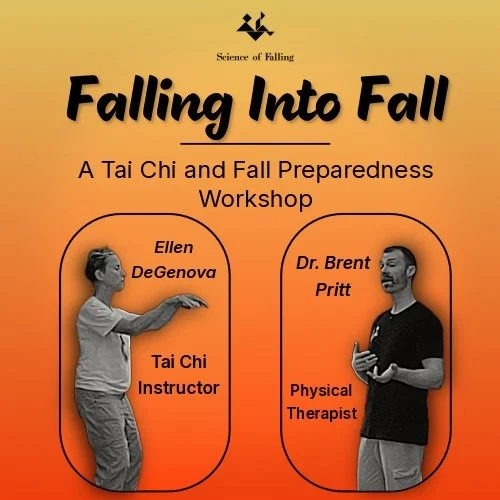
On October 3, 2026, I had the pleasure of joining Tai Chi instructor Ellen DeGenova for Falling Into Fall, a two-hour workshop in Cambridge, Massachusetts.
Our goal was to explore an important question: How can we better prepare our bodies for falls, not just work to prevent them?
Ellen guided participants through Tai Chi and Qigong-inspired movements focused on balance, weight shifting, relaxation, and body awareness. I followed with an interactive presentation on the science of balance, the importance of fall preparedness, and practical strategies for responding when balance fails.
We also had some excellent conversations with participants about fear of falling, osteoporosis, balance challenges, and the importance of building confidence in movement.
It was a wonderful opportunity to bring two complementary approaches together. While Tai Chi helps develop control, coordination, and awareness, fall preparedness adds another layer of protection by helping us understand what happens when we lose our balance.
You can watch the full workshop below!
Watch the Workshop: Falling Into Fall
Interested in bringing an interactive fall preparedness workshop to your community or organization? Explore my speaking and workshop offerings
Where Tai Chi Meets Fall Preparedness
One of my favorite parts of this workshop was seeing how naturally Ellen's Tai Chi instruction complemented the concepts I teach through Science of Falling.
Throughout her session, Ellen emphasized controlled weight shifting, body awareness, relaxation, and moving with intention. These are all valuable skills for maintaining balance and responding to changes in our environment.
My presentation built on those foundations by exploring what happens when balance becomes challenged, how we might respond when a fall is unavoidable, and what to do afterward.
Although our approaches come from different backgrounds, they share a common goal: helping people move with greater confidence, awareness, and independence.
Beyond Fall Prevention: What We Explored
Most people are familiar with fall prevention. We know that improving balance, building strength, and making our surroundings safer can reduce our risk of falling.
But there's another important question that doesn't get nearly enough attention.
What happens when our balance fails anyway?
That's where fall preparedness comes into play.
During the workshop, I introduced participants to what I call the Falling Continuum, which breaks a fall into three important phases:
Pre-Fall: The balance systems and protective reactions that help keep us upright.
The Fall: How we respond when recovery is no longer possible and how we might reduce injury.
Post-Fall: What to do once we're on the ground, including assessing injuries, seeking help, and safely recovering when appropriate.
Each phase offers opportunities to develop skills, build confidence, and become better prepared.
1. Balance Is More Than Strong Muscles
One of our first demonstrations explored the three sensory systems that help us maintain balance.
Vision: Our eyes help us understand our surroundings and orient ourselves in space.
Vestibular System: Our inner ears detect head movement and provide information about our position and motion.
Somatosensory System: Sensory information from our muscles, joints, and skin helps us understand where our body is positioned.
Your brain continuously integrates information from these systems to help keep you upright.
During the workshop, we explored how changing foot positions, turning the head, and removing visual information could make balancing more challenging.
One of the most important lessons was that being good at balancing in one situation doesn't necessarily mean you'll be equally stable in another.
For example, someone may walk confidently during the day but struggle when navigating a dark hallway or closing their eyes in the shower.
Understanding your individual challenges helps you train more effectively.
2. We Want to Be Overprepared, Not Just Prepared
Throughout our balance demonstration, I emphasized the importance of building more ability than everyday activities typically demand.
If ordinary walking represents the upper limit of your balance abilities, unexpected challenges can quickly become overwhelming.
That's why balance exercises sometimes look more difficult than the activities they're preparing us for.
Practicing narrower standing positions, controlled weight shifts, and head movements can help challenge our balance systems. These exercises should always be matched to your ability and performed with appropriate support.
The goal isn't to become a tightrope walker.
It's to make everyday movement feel easier, safer, and more manageable.
Tai Chi offers a wonderful opportunity to develop many of these abilities through purposeful, controlled movement.
3. Learning the Principles of Safer Falling
Perhaps the most unique portion of our workshop was our discussion of what happens when a fall becomes unavoidable.
I introduced participants to ROLL SAFE, my six-principle approach to understanding safer falling.
R — Relax: Avoid unnecessary rigidity and allow your body to absorb movement.
O — Observe: Develop awareness of obstacles and hazards in your surroundings.
L — Lengthen the fall: When possible, spread the impact over more time rather than stopping abruptly.
L — Land on the meaty bits: Favor larger, more muscular areas of the body rather than vulnerable bony structures when a safe option exists.
S — Shield the head: Prioritize protecting your head and other vulnerable areas.
AFE — Absorb, Flow, and Exhale: Work with the momentum of the fall rather than rigidly fighting against it.
These principles aren't guarantees against injury. Falls are unpredictable, happen quickly, and can produce significant forces.
However, understanding how the body responds to impact is an important part of developing fall preparedness.
We also demonstrated a controlled backward-falling technique to show how several of these principles can work together.
Important: Falling practice should be individualized and supervised by an appropriately trained professional. Don't attempt the demonstrated falls independently, particularly if you have osteoporosis, a history of fractures, or other medical concerns.
4. What Happens After a Fall Matters, Too
Even when a fall doesn't cause a major injury, being unable to get up can create serious problems.
I shared the experience of working with a patient who fell and remained on the floor for approximately 12 hours before someone found her.
Experiences like this are why I believe learning how to respond after a fall deserves just as much attention as preventing one.
If you fall, don't rush to stand up.
Take time to assess what happened, check for injuries, and determine whether moving is safe. If you suspect a serious injury, particularly to your head, neck, back, or hip, seek emergency assistance rather than attempting to get up.
When no serious injury is suspected and it's safe to move, having practiced appropriate floor-recovery techniques can make a tremendous difference.
Knowing how to call for help is equally important.
5. Confidence Is Part of Fall Preparedness
One of my favorite parts of the workshop was our discussion about fear of falling.
A previous fall can leave someone feeling embarrassed, anxious, or uncertain about their physical abilities. Sometimes that fear causes people to avoid activities they previously enjoyed.
Unfortunately, avoiding movement can contribute to further declines in strength, balance, and confidence.
Our goal shouldn't be to ignore that fear. Instead, we want to gradually rebuild confidence through appropriately challenging, achievable experiences.
This is another area where Tai Chi and fall preparedness work beautifully together.
Both approaches can encourage people to explore movement, recognize their capabilities, and progressively develop new skills.
Final Thoughts: Bringing It All Together
The biggest takeaway from Falling Into Fall is that preparing for falls involves more than any single exercise or technique.
We can improve balance, build strength, develop better protective responses, learn about safer falling, and practice what to do after a fall.
We can also learn to approach movement with greater confidence rather than allowing fear to dictate what we're willing to do.
I'd like to thank Ellen DeGenova for inviting me to participate and for sharing her wonderful approach to Tai Chi. I also want to thank everyone who attended, asked thoughtful questions, and helped make the workshop such an enjoyable experience.
Keep moving, keep learning, and keep preparing.
If you’d like to check out one of Ellen’s amazing Tai Chi classes make sure to check out her website at https://www.ellendtaichi.com/
What’s Your Fall Risk Score?
Most people don’t notice their balance declining until something goes wrong.
This 10-minute self-assessment will show you:
• How stable your balance really is
• Where you're most at risk (strength, coordination, or falling ability)
• What to focus on first
No equipment. No guesswork. Just clear answers.