
Shifting Priorities: From Fall Prevention to Fall Preparedness

Essential Points:
Fall prevention is essential, but it can’t eliminate every fall. Even strong, healthy, well-prepared people can lose their balance because of unexpected events, making prevention only one part of the solution.
Fall preparedness expands the goal from preventing falls to managing the entire fall experience. The SoF Fall Preparedness framework (Prevent → Recover → Fall → Protect → Rise → Return) creates multiple opportunities to reduce injury and preserve independence when prevention fails.
The future of fall care should prepare people for what happens when they fall. Building reactive balance, safe-falling skills, physical resilience, floor-transfer ability, and confidence can help people recover and return to the activities that matter to them.
Prefer to listen? Here’s a quick audio breakdown with a few extra insights:
For decades, the primary way we’ve approached falls has been through fall prevention.
And for good reason.
If someone is at risk of falling, we should probably try to make that fall less likely. We can improve strength and balance, review medications, address vision problems, modify the home, improve footwear, increase physical activity, and identify medical conditions that may contribute to instability.
These strategies matter a whole heck of a lot. That’s undeniable.
Exercise and multifactorial interventions can reduce fall risk, and modern guidelines rightfully place prevention at the center of current fall risk management. (1)
I have no interest in changing that, but what I think needs to change is where we stop that process.
Because you can have excellent balance, strong legs, good vision, a safe home, and years of training behind you, yet still fall.
You step on a patch of black ice. Someone accidentally bumps into you. A dog runs underneath your feet. You miss a stair. Your blood pressure suddenly drops after standing up. You catch a foot on something you never saw while talking to a friend. And suddenly, through no real fault of your own, your balance is gone. You’re in the air and have to deal with what comes next.
Now what?
That question is where fall prevention begins to run out of answers. In fact, most of the time, it doesn’t have any answers at all. Traditional fall-prevention has generally had very little to say about what happens once prevention fails.
The good news is that this is exactly the gap fall preparedness is starting to address as it catches on.
The only thing is that the idea of fall preparedness is in its infancy.
When I started Science of Falling in 2020, and during my PT schooling from 2017–2020, this wasn't something I encountered much at all in my education or clinical training. That’s the whole reason I started this website in the first place. It was a glaring weakness in the medical system, and a giant disservice to anyone who was promised a safer life.
Prevention Is Important, It Just Isn't the Whole Problem
The goal of fall prevention is usually straightforward.
Identify the things that make someone more likely to fall and change as many of them as possible. Simple as that.
That approach has produced an enormous body of research and some very useful interventions. The 2022 World Guidelines for Falls Prevention and Management, for example, recommend physical activity, exercise, risk assessment, and personalized multidomain interventions depending on an individual's level of risk. (1)
We should keep doing those things. They do work to reduce falls significantly.
But prevention can only reduce risk. It can’t reduce it to zero. Falls still happen often.
I’ve seen this firsthand in my own work as a physical therapist in assisted livings. Fall prevention is a huge part of what I do, and I’ve worked with patients who could crush some pretty difficult balance tests, look strong and steady on difficult obstacle courses, and still later suffer an unexpected fall that resulted in a serious injury.
Those experiences didn’t make me question whether working on balance and general fall prevention was a productive idea. Instead, they made me question whether fall prevention was enough and further re-affirmed my belief that we need to do more for those in need.
Because you can have great balance, be strong, and you can do everything right. But eventually something outside of your control can, and probably will, still knock you off your feet. And when that happens, what have we, the healthcare professionals, prepared you to do next?
That distinction matters. It only takes one fall to alter your life for good.
When we build our entire approach around whether a fall occurred, we create a very binary definition of success:
Did the person fall? No? Success. Yes? Failure.
But a fall is far more complicated than that, because we should care less about the fall itself and more about a person getting hurt. We should care about the quality of a fall.
Someone can lose their balance and recover. Someone can fall and avoid hitting their head. Someone can change the way they hit the ground. Someone can reduce the forces involved in the impact. Someone can fall, safely get themselves off the floor, figure out what went wrong, and return to the activities they care about.
Those are all meaningful outcomes. Those outcomes translate to a resilient life and a solid healthspan (the number of years not limited by health problems).
If our only goal is preventing the initial fall, we risk ignoring all of them.
I’d rather have someone be able to fall 100 times uninjured, than have someone fall once and break a hip.
That’s why I think our larger goal in the medical and fitness worlds should be fall preparedness.
What Is Fall Preparedness?
Fall preparedness asks a broader question, how do we prepare someone for everything that can happen before, during, and after a fall?
This doesn't replace fall prevention, it puts it into a larger more comprehensive system.
The idea is to build as many layers of protection as possible so that if one layer fails, another opportunity still exists to improve the outcome.
Interestingly, the research world has begun moving in a similar direction.
In 2021, Soh and colleagues proposed an expanded way of thinking about falls efficacy, or a person's confidence in their ability to manage fall-related situations. Instead of focusing only on balance confidence, they described four domains spanning pre-fall, near-fall, fall-landing, and completed fall. (2)
That perspective is important because each stage demands different abilities.
Maintaining your balance is a different skill from recovering from a sudden perturbation (a force knocking you off balance). Recovering your balance is different from responding when recovery is no longer possible. Falling is different from getting yourself back off the ground afterward.
More recently, the term fall preparedness itself has begun appearing in the literature.
A 2026 e-Delphi study involving geriatric physical therapists reached consensus on 43 strategies for a fall preparedness and recovery program, organized around education, fall-landing strategies, and floor transfers. The overlap with the broader idea behind my Falling Continuum was instantly noticeable. The authors specifically described preparedness as a way to complement traditional prevention by preparing people for the fall event and what happens afterward. (3)
Then, in July 2026, researchers writing in The Lancet Healthy Longevity proposed a Falls Resilience Framework that moves beyond risk reduction alone and considers the entire fall-related process: resisting destabilizing challenges, mitigating injury when falls occur, and recovering function and mobility afterward.(4)
The terminology and individual frameworks are different. But the direction is quite similar, and right in line with my mission for the last six years.
Prevent the fall when you can. Prepare for what happens when you can't.
The SoF Fall Preparedness Framework
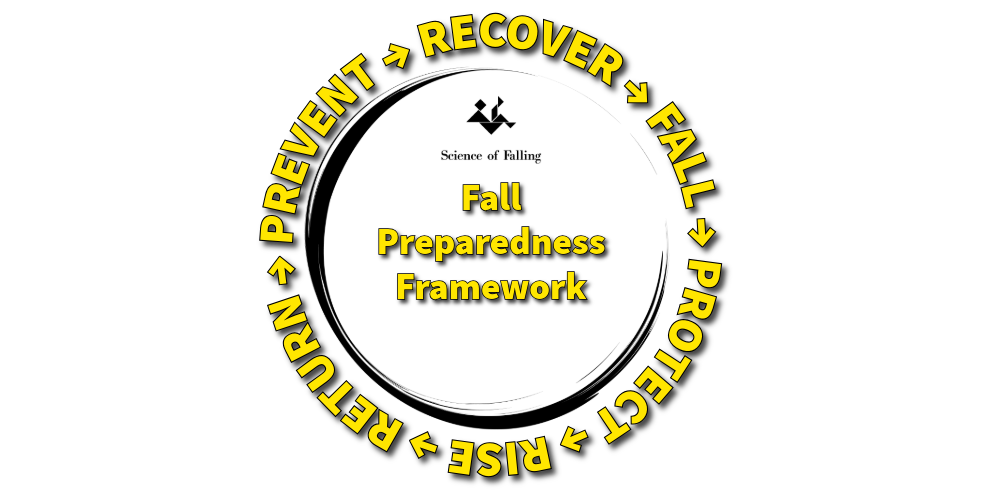
I use the Science of Falling Fall Preparedness Framework, a simple six-part model for explaining this broader approach:
PREVENT → RECOVER → FALL → PROTECT → RISE → RETURN
These aren’t necessarily six steps that every person moves through. Ideally, you succeed at the first one. If prevention works, the rest of the chain never occurs.
But when one layer fails, the next layer gives us another opportunity to influence what happens and prevent serious injury.
That’s the major philosophical difference between fall prevention and fall preparedness. A loss of balance doesn’t mean we have run out of options.
1. Prevent
Can we stop the loss of balance from happening in the first place?
This is the part of the framework we already know well. Strength matters. Balance matters.
Vision, sensation, medication management, home safety, footwear, physical activity, cognition, and medical conditions can all affect fall risk.
This remains the foundational fall prevention we all know and love. If I can make someone less likely to fall, I want to do that. But preparedness also changes how I think about prevention.
The goal shouldn’t be to remove every challenge from someone's life until falling becomes impossible. That can create its own problems if safety comes at the expense of movement, confidence, physical capacity, or independence.
At that point the movie Bubble Boy becomes real and that’s no life worth living.
The better goal is to build a person who is increasingly capable of navigating the challenges they are likely to encounter in their own daily life.
And occasionally, one of those challenges will still win. That’s life, and gravity is still the undefeated winner.
That brings us to the second layer.
2. Recover
Once balance is thrown off, can you stop a fall from happening?
There is a significant difference between maintaining your balance and recovering your balance.
Standing on one leg is balance.
Walking across an uneven yard and quickly taking an extra step when your foot slips is something else.
What we call reactive balance involves detecting instability and producing an appropriate response quickly enough to prevent the fall from continuing.
Sometimes that means stepping via a stepping reaction.
Sometimes it means reaching for support via a reaching reaction.
Sometimes it means changing the position of the body to bring the center of mass (CoM) back under control.
This relates closely to what researchers have described as the near-fall domain of falls efficacy, your ability to recover after balance has already been thrown off. (2)
This is an important idea.
We shouldn’t only train people to have good balance. We should also train them to lose their balance and get it back. Yes, that means purposefully knocking people off balance (safely of course).
But eventually we reach a point where recovery is no longer possible.
And this is where the way we think about falling needs to change the most.
3. Fall
If the fall can’t be stopped, can you manage the descent?
This question was one of the original reasons I created Science of Falling.
When I first became interested in this subject, I was blown away by how little attention was given to the actual act of falling.
We trained people not to fall. Then, if they fell anyway, we largely dealt with the consequences afterward.
There were exceptions of course.
Martial arts have taught breakfalls for generations. Gymnastics, stunt work, certain sports, and a handful of training programs around the world have treated falling as something that can be practiced. Historically, much of the most visible fall training lived in sports and martial arts settings, although a small body of rehab research had started exploring these ideas in older adults.
In mainstream health and rehabilitation, deliberately preparing someone for the physical event of falling was (and is) far less common. And when falling techniques are taught, specific techniques may not translate equally well across every fall direction, environment, or population.
Research supports at least the plausibility of training falling.
A 2017 systematic review and meta-analysis examined 13 studies of different landing strategies and found that techniques including squatting, elbow flexion, rotation, rolling, relaxation, and stepping could alter impact loads. The researchers also emphasized an important limitation, much of the available evidence involved younger adults and controlled or self-initiated falls, meaning much more research is needed before translating specific techniques broadly to older or medically vulnerable populations.(5)
That’s an important limitation, and I don't think we should pretend the science is further along than it is. Like I said earlier, fall preparedness is in its infancy.
But it also raises an important question.
If the way you move during a fall can influence the forces your body experiences, why wouldn't we study and train that part of the problem too?
This is where I use another Science of Falling teaching concept, The Falling Continuum.
The Falling Continuum treats a fall not as a single moment when the body hits the ground, but as a sequence of events:
Pre-fall → Fall → Post-fall
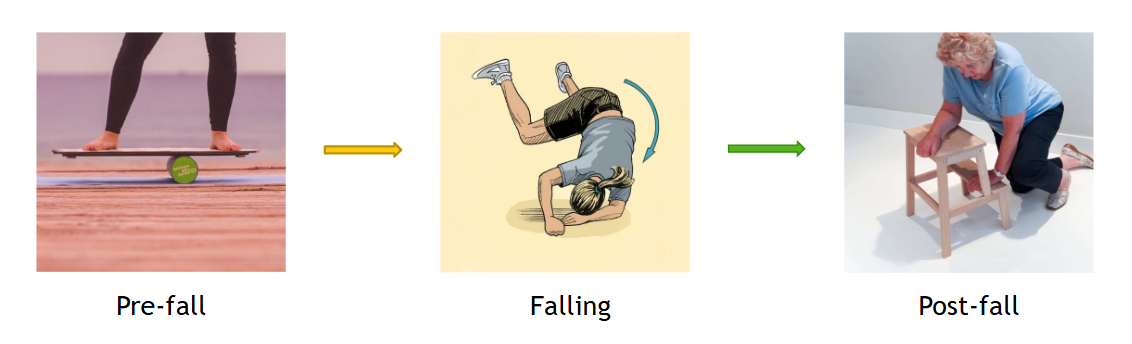
Within that sequence are opportunities to influence what happens. Before the fall there may be opportunities to recover. During the fall there may be opportunities to alter movement and impact. Afterward there are decisions about injury, getting up, seeking help, and recovering.
When we zoom even further into the actual falling phase, I use the ROLL SAFE principles:
R — Relax the body
O — Observe your surroundings
L — Lengthen the fall
L — Land on soft areas (the meaty bits)
S — Shield the head
AFE — Absorb, flow, exhale

ROLL SAFE isn’t meant to suggest that every fall has one perfect technique. Real-world falls are messy, fast, unpredictable, and highly individual.
Instead, these are general principles for thinking about how the body might manage an unavoidable fall.
Stay loose rather than becoming unnecessarily rigid. Recognize what is around you when time allows. Increase the time and distance over which your body decelerates when possible. Avoid concentrating impact unnecessarily onto vulnerable areas. Protect the head. Absorb and flow with the forces of the fall rather than fighting every bit of motion.
Real and specific techniques do exist, but they shouldn't be taught until a person understands the fundamentals of safe falling.
The Fall Preparedness Framework is the big picture.
The Falling Continuum helps us understand the event, especially in the context of my professional viewpoint of physical therapy.
ROLL SAFE gives us principles for responding within it during those crucial seconds of a fall.
4. Protect
If impact occurs, how can we reduce the chance that it becomes a serious injury?
Falling and injury are related, but they aren’t synonymous.
The purpose of this stage is to think beyond whether ground contact occurs and toward what happens when it does.
Part of protection occurs through movement and mastering the act of falling itself. Head protection, joint positioning, rotation, force distribution, and how the body decelerates can all influence the impact.
But protection is also something we build long before the fall.
Strength matters. Muscle mass matters. Bone health matters. The physical capacity of the body to tolerate force matters. The environment matters. And for specific people or settings, protective equipment may matter.
The goal isn’t to make falling harmless. That would be unrealistic.
The goal is to give the body the best possible chance to withstand an event we were unable to prevent. And we do that on top of safe falling principles.
The research on deliberate safe-falling training is still developing, but some early work is encouraging. Participants in the FAlling Safely Training, or FAST, study reported increased confidence in their ability to fall without injury, and participants who experienced falls after completing the training reported using techniques they had learned. This was a small qualitative study, so it can’t demonstrate that the program reduces injuries at a population level, but it shows that older adults can engage with this kind of training and perceive it as useful. (6)
The question is no longer whether the landing phase deserves study. It clearly does. And in all honesty, I think it's a disservice that this part of the fall problem wasn't studied more extensively much earlier.
The bigger question is how we determine which approaches are safe, teachable, adaptable, and effective for different populations.
5. Rise
Once the fall is over, what happens next?
This stage is quite easy to overlook, and the required strength needed to rise can often be underestimated.
A person may avoid serious injury and still find themselves lying on the floor without the ability or confidence to get up.
Fall preparedness therefore needs to include post-fall decision-making.
Are you injured? Did you hit your head? Should you attempt to move? Can you get yourself up safely? If you can’t, can you access help? And if getting off the floor is appropriate, have you ever actually practiced doing it? It’s a trainable skill after all.
The 2026 fall preparedness Delphi study placed floor transfers alongside education and fall-landing strategies as one of its three major themes. (3)
That makes sense.
Getting off the floor isn’t simply something that happens after the "real" fall problem is over.
It’s part of fall preparedness and the fall problem as a whole.
6. Return
Can you return to your life afterward?
I think this may be one of the most important parts of the framework. Because physically getting back onto your feet doesn’t necessarily mean you have recovered. An after action report, at least in your head, needs to be done.
What caused the fall?
Does something need to be medically evaluated?
Did you suffer an injury?
Did the experience expose a weakness in your balance, strength, reaction time, environment, or decision-making?
And perhaps most importantly, what did the fall do to your confidence?
A frightening fall can change the way you move through the world. A real life-altering fear of falling can crop up.
You stop taking walks. You stop using stairs. You stop traveling. You stop exercising. Your world slowly becomes smaller because avoiding another fall begins to feel safer than participating in life.
True fall preparedness shouldn’t end when someone stands back up.
The final goal is return.
Return to movement. Return to activity. Return to confidence. Return to the parts of life that matter.
That doesn’t mean ignoring fear or recklessly pushing through it. It means understanding what happened, addressing what can be changed, rebuilding capacity, and gradually restoring confidence.
The real goal is preventing the fall from permanently changing the size of your life.
The Research Is Moving In The Same Direction

One of the most encouraging parts of building Science of Falling has been watching the literature move toward many of the same ideas I arrived at independently through my clinical work and exploration of falling.
I did not start with a paper telling me that we needed "fall preparedness."
I started with a much simpler observation.
People fall. Even people with good balance fall. Even athletes fall. Even people who have done everything correctly fall.
And yet, outside of a few specific sports, martial arts, and small training programs, deliberately practicing what to do when a fall becomes unavoidable seemed quite uncommon.
That never made sense to me, but maybe that was because I was in the sport of parkour which quite literally uses parkour ukemi as a foundation for safety at all times.
Preparation isn’t an admission that prevention has failed. It’s recognition that risk can rarely be eliminated completely and we should therefore prepare for the worst.
Now we’re beginning to see that idea reflected in falls research.
The expanded falls efficacy model pushed the conversation beyond simple balance confidence.(2) Researchers have begun directly investigating safe-falling training. (6) A 2026 expert consensus study explicitly used the language of fall preparedness and recovery. (3) And the newly proposed Falls Resilience Framework argues that fall management should consider our ability to resist a challenge, mitigate harm when the event occurs, and recover afterward.(4)
These developments do not mean we have solved the problem.
We haven't. Not even close my friends.
There are still major questions around who should practice falling, how techniques should be modified for different populations, which strategies transfer into unexpected real-world falls, how training should progress safely, and whether these programs ultimately reduce serious injuries.
The 2026 fall preparedness consensus paper is especially careful about this.
Expert agreement on what a program should contain isn’t the same thing as evidence that the program reduces injuries. The authors call for feasibility studies, randomized trials, safety monitoring, and longer-term outcome research before widespread implementation. (3)
That caution is appropriate, but I also think we're moving in the right direction.
We’re beginning to ask a bigger question than, how do we stop people from falling?
We’re beginning to ask, how do we make people more capable when facing the entire problem of falling?
Final Thoughts: The Future Should Be Prepared
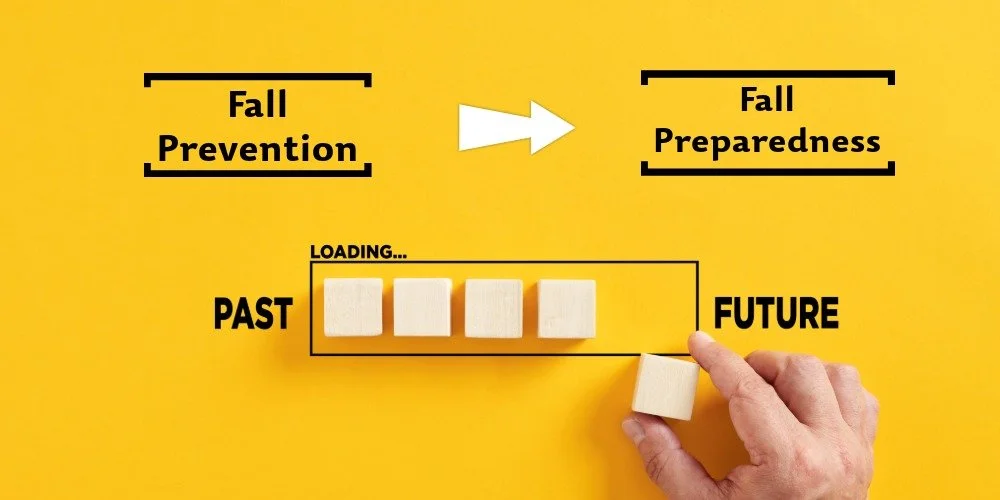
I don't want fall preparedness to replace fall prevention. I want fall prevention to be the first step in fall preparedness.
But then keep going.
Practice recovering from instability. Develop strategies for unavoidable falls when appropriate. Build a body better prepared to tolerate impact. Know how to respond from the floor. And make returning to activity and confidence part of the plan.
That’s what the Fall Preparedness Framework is meant to represent:
PREVENT → RECOVER → FALL → PROTECT → RISE → RETURN
Six opportunities to be safe.
Six different questions to answer before an emergency arises.
Six places where we may be able to change the outcome of a potential life-altering fall.
I believe this broader approach has the potential to become an important part of the future standard for dealing with fall risk. It's my long-term mission to help make that happen through this website, my future projects, and hopefully one day healthcare as a whole.
Maybe one day, telling someone at risk of falling only how to prevent a fall will feel incomplete, unprofessional, and frowned upon. Not because prevention has been a wrong avenue of help, but rather because we finally recognized that falling is a much bigger problem than prevention alone can solve.
The future of fall care shouldn’t be prevention versus preparedness.
It should be prevention within preparedness.
What’s Your Fall Risk Score?
Most people don’t notice their balance declining until something goes wrong.
This 10-minute self-assessment will show you:
• How stable your balance really is
• Where you're most at risk (strength, coordination, or falling ability)
• What to focus on first
No equipment. No guesswork. Just clear answers.
References
Montero-Odasso M, van der Velde N, Martin FC, et al. World guidelines for falls prevention and management for older adults: a global initiative. Age Ageing. 2022;51(9):afac205. doi:10.1093/ageing/afac205.
Soh SLH, Tan CW, Thomas JI, et al. Falls efficacy: extending the understanding of self-efficacy in older adults towards managing falls. J Frailty Sarcopenia Falls. 2021;6(3):131-138. doi:10.22540/JFSF-06-131.
Dudash S, Ickert E, Ward R, Ge W, Campbell M. Designing an effective fall preparedness and recovery program for older adults: an e-Delphi study. BMC Geriatr. 2026;26:465. doi:10.1186/s12877-026-07203-5.
Ravi DK, Hausdorff JM, Whitson HE, van der Velde N, Weerdesteyn V, Melis RJ. Falls resilience framework: advancing from risk reduction to resilience building in older adults. Lancet Healthy Longev. Published online July 27, 2026. doi:10.1016/j.lanhl.2026.100880.
Moon Y, Sosnoff JJ. Safe landing strategies during a fall: systematic review and meta-analysis. Arch Phys Med Rehabil. 2017;98(4):783-794. doi:10.1016/j.apmr.2016.08.460.
Zanotto A, Zanotto T, Alexander NB, Sosnoff JJ. Views and experiences of older people taking part in a safe-falling training program: lessons learned from the FAlling Safely Training (FAST) trial. BMC Geriatr. 2024;24:818. doi:10.1186/s12877-024-05382-7.