
How Much Balance Training Is Enough?

Essential Points:
You may only need 10–15 minutes of focused balance training to start improving. Short, challenging sessions performed consistently can produce meaningful gains in balance performance, especially when the exercises are appropriate for your ability level.
Improving balance and reducing fall risk aren’t the same goal. Research suggests that meaningful, long-term fall-risk reduction may require roughly 50 cumulative hours of challenging, balance-focused exercise, not just a few minutes here and there.
The best balance program is about more than time. Specificity, progressive challenge, variety, consistency, and long-term maintenance all matter. Balance training should evolve from simple exercises toward the real-world challenges you actually need to handle.
Balance exercises are often prescribed with surprisingly little guidance. It’s a little like the wild west in a way sometimes.
Stand on one leg while brushing your teeth. Practice a few exercises at the kitchen counter. Attend a balance class once or twice a week. These can all be useful suggestions, but they leave out an important part of the equation.
How much balance training do you actually need to make a real difference?
This is a difficult question because balance isn’t trained as neatly as strength or endurance. If I prescribe a strengthening exercise, I can record the weight, repetitions, sets, and percentage of someone’s maximum effort. If I prescribe aerobic exercise, I can use heart rate, pace, distance, or time.
Balance doesn’t usually come with such clean measurements (although you can change that with these tools).
Standing with your feet together might be extremely challenging for one person and effortless for another. Both people could complete the same exercise for the same amount of time while receiving completely different training effects.
The research doesn’t give us one perfect formula, but two papers offer some useful clues. One suggests that balance can improve with focused sessions lasting only 11 to 15 minutes. The other argues that meaningful, sustained fall-risk reduction might require at least 50 total hours of exercise. (1, 2)
Those recommendations sound wildly different, but they begin to make sense when we look at what each paper was actually trying to accomplish.
The 15-Minute Balance Prescription
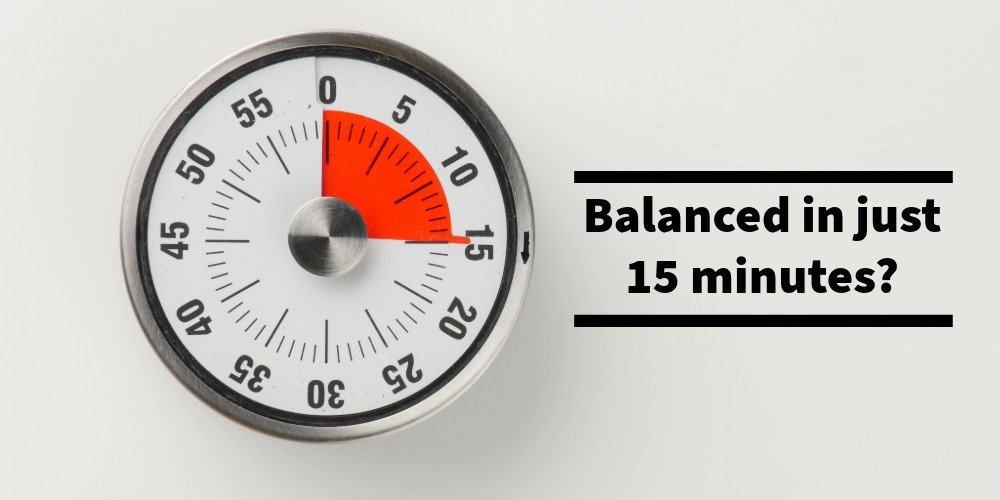
In 2015, Lesinski and colleagues published a systematic review and meta-analysis examining the effects of balance training in healthy adults between the ages of 16 and 40. (1) The review included 25 randomized controlled studies and attempted to identify the balance-training variables associated with the greatest improvements.
The researchers found that balance training improved both steady-state and proactive balance.
Steady-state (static) balance refers to maintaining control during a relatively stable position, such as standing on one leg. Proactive balance involves maintaining stability during an anticipated movement, such as reaching beyond your base of support or stepping over an obstacle.
Based on their analysis, the most effective balance-training prescriptions included:
A program lasting 11 to 12 weeks
Approximately three training sessions per week
At least 16 to 19 total sessions
Sessions lasting 11 to 15 minutes
Four balance exercises per session
Two sets of each exercise
Approximately 21 to 40 seconds per exercise
That sounds like a pretty clean recipe. In fact, I originally used this research as part of the foundation for designing my own balance program, Master Your Balance. It provides practical numbers without requiring someone to spend an hour every day standing in difficult positions.
Short sessions are also easier to fit into real life. A focused 15-minute routine can be completed before work, after a walk, or as part of a larger workout. You don’t necessarily need a separate hour-long balance workout to begin seeing improvement.
However, this recipe comes with several limitations.
The Recipe Isn’t as Exact as It Looks

The participants in the Lesinski review were healthy adults between 16 and 40 years old. We can’t automatically assume that the same prescription is ideal for an 80-year-old with neuropathy, muscle weakness, a history of falls, or difficulty walking, which describes the majority of the patients I treat in real life.
The detailed dose findings also applied primarily to steady-state balance. The authors found too few studies examining proactive and reactive balance to establish reliable dose-response relationships for those abilities.
Reactive balance, a form of dynamic balance, is your ability to respond after something unexpectedly disrupts your stability. This includes taking a quick step after a trip, grabbing a railing, or moving your body to keep your center of mass over your feet.
That is a major limitation when discussing falls.
Many falls aren’t slow, controlled failures during a single-leg stance test. They happen after an unexpected trip, slip, collision, or change in the environment. Reactive balance plays a major role in whether that disruption becomes a fall.
The studies included in the review were also of modest quality overall. Only seven of the 25 were classified as high quality, and the average PEDro score was 5 out of 10 (higher numbers meaning better quality). The authors also noted that they couldn’t completely separate the influence of frequency, session length, program duration, and other training variables.
There is even a mathematical mismatch within the recommendations. Three sessions per week for 11 to 12 weeks would equal 33 to 36 sessions, not 16 to 19. These numbers came from separate comparisons across different studies. They are useful guideposts, but they shouldn’t be assembled into a perfect formula that was directly tested as one complete program.
Most importantly, the review examined improvements in balance performance. It didn’t establish how much training older adults need to reduce their chances of falling.
That brings us to a very different number.
The 50-Hour Reality

In 2025, Allison and Schrodt published a review examining the exercise dose needed to produce long-term fall-risk reduction in older adults. (2)
Instead of asking how quickly someone can improve a balance test, the authors focused on a larger outcome. They wanted to know how much exercise might be needed to create a substantial reduction in fall occurrence.
Based on previous systematic reviews and successful fall-prevention programs, the authors concluded that approximately 40 to 54 total hours of exercise is most likely needed. Some of the most successful programs provided between 54 and 60 hours.
Their general recommendation included:
Three or more exercise sessions per week
Approximately 40 to 90 minutes per session
At least 12 weeks of structured training
Moderate to high levels of balance challenge
At least 50 cumulative hours of upright, balance-focused exercise
Continued balance activity after the structured program ends
The exact exercise also matters.
Effective programs emphasized upright balance training, gait activities, a gradually reduced base of support, less reliance on the arms, and progressively more difficult challenges. Reactive-balance training, lower-extremity strength, and power exercises can also be included based on the person’s needs.
This doesn’t mean that strength training, walking, stretching, and aerobic exercise aren’t valuable. All of them provide important health benefits. However, strength training by itself isn’t the same as balance training. Walking on a predictable, level surface can provide too little balance challenge to create the desired changes.
If the goal is to reduce falls, the program must actually challenge the systems and situations involved in maintaining and recovering balance.
Nine Hours Versus 50 Hours

This is where we need to compare these studies and drill a little deeper.
If someone completes 15 minutes of balance training three times per week for 12 weeks, they will accumulate about nine total hours of training.
That’s great, but nowhere near 50 hours.
The difference doesn’t necessarily mean that one paper is right and the other is wrong. The studies were looking at different populations and different outcomes.
The Lesinski review involved healthy younger adults and measured changes in balance performance. The Allison and Schrodt paper focused on older adults and the larger goal of sustained fall-risk reduction. Both are important.
These outcomes are related, but they aren’t interchangeable.
A person can improve how long they stand on one leg without proving that they are less likely to fall over the following year. They can improve on a clinical balance test without improving their response to an unexpected trip. They can also become better at the exact exercises they practiced without seeing the same improvement in every real-world situation.
Balance training appears to operate on two different clocks.
The first is the improvement clock. This measures how quickly someone can produce a detectable improvement in balance performance per research.
The second is the protection clock. This measures the accumulated time training needed to translate those improvements into meaningful, lasting changes in real-world fall risk.
The improvement clock might begin progressing with relatively short sessions. Just 15 minutes a session can get it moving in the right direction. The protection clock likely requires a larger and more variable training dose, building large swaths of cumulative time.
This is similar to strength training. Someone who has never lifted weights probably will become measurably stronger within a few weeks as their nervous system gets more efficient. That doesn’t mean those early strength gains came entirely from building new muscle.
The first program creates an initial strength adaptation. Continued training builds real noticeable muscle and strength gains for improved performance in their life.
Balance appears to work in a similar way.
More Than Minutes

It would be easy to read this research and focus entirely on time. Fifteen minutes per session. Three sessions per week. Fifty total hours. Sure, time matters, but it is only one part of the dose.
An effective balance program also needs specificity, challenge, accumulation, and maintenance.
Specificity
Balance is very specific to the task being performed.
Practicing single-leg stance will probably improve single-leg stance, but it doesn’t guarantee the same improvement while walking across an uneven lawn, turning quickly, stepping over an obstacle, or responding to a trip.
This doesn’t make single-leg balance useless. It means that one exercise can’t represent the entire balance system. It just unfortunately isn’t that simple.
A more complete program should expose someone to different balance challenges. This can include static positions, reaching, stepping, walking, turning, changing speeds, moving the head, reducing visual input, managing another task, and reacting to unexpected disturbances. Essentially working all aspects of needed balance.
The exercises should also reflect the person’s personal needs. A hiker, an athlete, and an older adult who wants to safely walk to the mailbox might require different types of balance practice.
Challenge
Balance exercises have to be difficult enough to stimulate change.
This is a law of adaptation in the body and might just be the most important ingredient in the entire recipe besides time.
Standing with both hands firmly planted on a countertop can be appropriate when someone is first learning an exercise. If they can perform it easily, though, it no longer provides enough challenge to improve their balance.
Challenge can be increased by:
Narrowing the base of support
Reducing hand support
Changing the surface
Reaching in different directions
Adding head or body movements
Increasing speed
Adding stepping
Performing another task at the same time
Reducing visual information when appropriate
Introducing safe reactive-balance activities
The goal isn’t to make every exercise dangerous. It’s to bring someone close enough to the edge of their current ability that the balance system has a reason to adapt.
As a rough clinical rule, I often tell my patients that an exercise should produce a noticeable wobble, corrective step, or brief use of support about 25% of the time. In other words, they should remain successful most of the time, but the exercise shouldn’t look perfect on every attempt.
That 25% is not a scientifically established cutoff.
Balance research has not yet identified an ideal failure rate. However, broader motor-learning principles support practicing at a level that produces useful errors without overwhelming a person. A wobble that someone successfully corrects isn’t necessarily a failure. That correction is part of what they’re training.
People with significant balance problems most likely require guarding, stable supports, or professional supervision to safely reach an appropriate level of challenge. An exercise can be challenging without being reckless.
Accumulation
Short balance sessions can be extremely useful. They are easier to complete consistently and can be added to an existing routine.
But, those short sessions still need to accumulate time.
Fifteen minutes performed three times per week adds up to only 45 minutes per week. At that pace, reaching 50 hours would take more than a year.
Someone working toward long-term fall-risk reduction might need to accumulate additional balance time through longer sessions, home exercises, gait training, Tai Chi, evidence-based community programs, or appropriately challenging hobbies.
Not every minute spent standing or walking automatically counts as balance training. The activity still needs to create a meaningful challenge.
The 15-minute session is therefore best viewed as a building block in the grander balance program rather than the entire structure.
Maintenance
Balance training doesn’t have a permanent finish line. Improvements can gradually be lost if they aren’t maintained.
This is important because fall risk isn’t usually a short-term condition. Strength, sensation, vision, medications, health conditions, confidence, activity levels, and the environment can all change over time.
A few weeks of physical therapy may begin the process as it can identify specific problems, teach appropriate exercises, build confidence, and create measurable improvement. However, it’s probably not going to provide the needed lifetime dose of balance training.
The newer review compares fall-risk management to cardiac rehabilitation. After the initial phase of professional care, the person transitions toward long-term independent or community exercise. The initial treatment is important, but it isn’t meant to be the entire intervention.
You might finish physical therapy, but you shouldn’t necessarily finish challenging your balance.
A Practical Starting Point
The research doesn’t support one universal program for every person. Still, it gives us a reasonable place to begin, in an otherwise large sea of confusing information.
For a healthy adult trying to improve general balance performance, a starting program might include:
Three focused sessions per week
Approximately 10 to 15 minutes per session
Four different balance activities
Two sets of each activity
Attempts lasting approximately 20 to 40 seconds
Regular progression as the exercises become easier
At least 11 to 12 weeks of consistent practice
For an older adult working toward fall-risk reduction, the larger plan might need to include:
Three or more balance-focused sessions per week
Upright and dynamic exercises
Moderate to high relative balance challenge
Gait, turning, reaching, and stepping practice
Lower-extremity strength and power training
Reactive-balance activities when they can be performed safely
A structured program lasting at least 12 weeks (but usually beyond)
A long-term goal of accumulating approximately 50 hours
Continued balance training after the initial program
These aren’t rigid rules. Someone with severe balance issues may need shorter, closely supervised sessions. Someone with advanced balance ability might require more complex activities to create the same relative challenge.
The program has to meet the person where they are and continue moving forward as they improve.
Final Thoughts: There Is No Perfect Dose
So, how much balance training is enough?
Enough to begin improving your balance is probably less than you think. Focused sessions lasting 10 to 15 minutes can produce meaningful changes when the exercises are appropriate, challenging, and repeated consistently.
Enough to meaningfully reduce fall risk over the long term could be a bit different. That process appears to require months of practice, dozens of accumulated hours, and continued exposure after the initial program ends. No small feat, but still important.
The science doesn’t give us one perfect prescription. It gives us a more useful way to think about balance training, and maybe some minimum standards to meet if we want to cover our bases.
Short sessions can start the process. Challenge creates the stimulus. Variety helps the improvements transfer. Consistency allows the work to accumulate. Maintenance helps preserve what was gained.
You might finish a balance program. You’re never permanently finished training balance. Instead, you should use that knowledge to maintain and continue improving.
Balance training also remains only one part of fall preparedness. It can reduce the likelihood that a fall occurs, but it can’t eliminate every trip, slip, medical event, or unexpected disruption. We have to also think about strength, environmental hazards, decision-making, reactive responses, safer landing strategies, and the ability to recover after a fall.
Balance training helps us stay on our feet. Fall preparedness recognizes that we must also be ready for the moments when balance isn’t enough.
What’s Your Fall Risk Score?

Most people don’t notice their balance declining until something goes wrong.
This 10-minute self-assessment will show you:
• How stable your balance really is
• Where you're most at risk (strength, coordination, or falling ability)
• What to focus on first
No equipment. No guesswork. Just clear answers.
References
Lesinski M, Hortobágyi T, Muehlbauer T, Gollhofer A, Granacher U. Dose-response relationships of balance training in healthy young adults: a systematic review and meta-analysis. Sports Med. 2015;45(4):557-576. doi:10.1007/s40279-014-0284-5
Allison LK, Schrodt LA. How much is enough? Dosing balance exercise to achieve long-term fall risk reduction. Top Geriatr Rehabil. 2025;41(4):237-252. doi:10.1097/TGR.0000000000000484