
Your Strongest Leg Might Not Be Your Best Balance Leg

Essential Points:
Your strongest leg isn't necessarily your best balance leg. Strength, movement preference, and balance are different abilities, and the leg you consider "good" may not be the one that performs best during balance tasks.
Your legs can have different jobs. One leg may be better at producing movement, like kicking, while the other provides stability and support, and research suggests there isn't a universally dominant leg for every task.
Balance testing should go beyond simple strength comparisons. Challenging different balance tasks can reveal side-to-side differences that basic strength tests or easy balance exercises may miss, helping identify what each leg actually does well.
Over the last few years, I've evaluated a lot of people with balance problems. It’s basically 90% of my patient base at this point, and I love it.
During an initial evaluation, I'll usually look at several things including strength, walking, sensation, and different types of balance. Somewhere along the way, I'll often ask a simple question:
"Which leg do you consider your better leg?"
Most people have an answer right away:
"My right leg."
"My left leg has always been the weak one."
"This knee is bad, so the other leg is definitely my good leg."
And a lot of the time, they're right…at least when it comes to strength. If someone tells me their right leg feels stronger, basic strength testing will often back that up.
Then we get to balance, and sometimes everything flips.
The leg they swear is their "good leg" struggles during single-leg balance, while the supposedly weaker leg does just fine and maybe even excels.
I've seen this enough times that I don’t think it’s necessarily a fluke. And it’s become something I’ve deeply thought about on a few occasions, but today I want to finally answer the question, “what exactly makes a leg your good leg?”
Because strength, leg preference, and balance aren't the same thing.
Your Body Doesn't Necessarily Have One Good Side
We tend to think about dominance pretty simply. If you're right-handed, your right side is your dominant side.
But the legs don't always work that neatly.
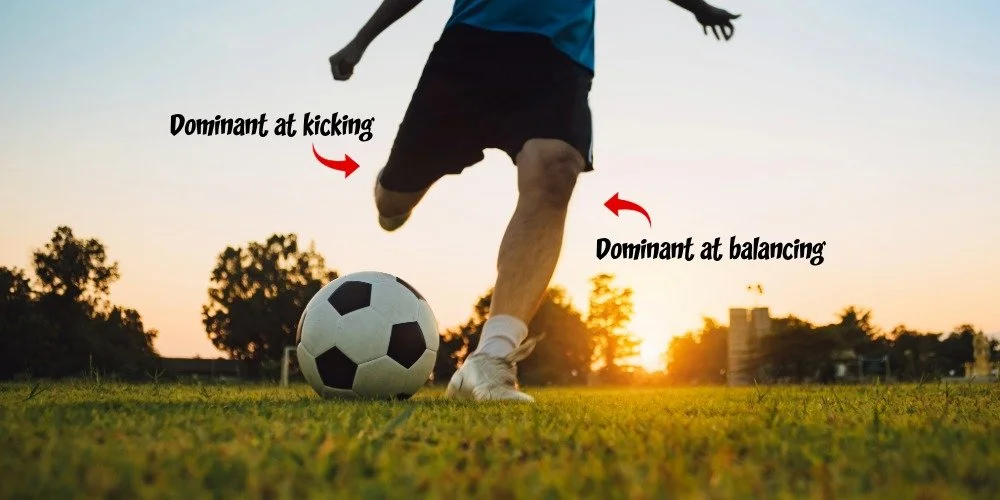
Think about kicking a soccer ball.
If you prefer kicking with your right foot, that leg gets the obvious job. It swings forward, generates speed, and makes contact with the ball.
But your left leg has an important job too. It has to support your entire body while the right leg moves through space.
One leg creates movement.
The other provides the stable platform that allows that movement to happen.
Researchers have described similar differences in lower-limb dominance. The preferred leg for manipulating an object or initiating movement isn't always the same leg preferred for tasks involving support or stability. (1, 2)
That doesn't mean everyone has one permanent "movement leg" and one permanent "balance leg." But it does show why calling one leg simply better can get complicated.
Thought Experiment: Let's Make Some Mac and Cheese
You can see a similar idea with the arms.
Imagine you're making mac and cheese, a classic favorite.
If you're right-handed, there's a good chance your left hand holds the pot while your right hand stirs.
The right hand gets the flashy job. It's moving, stirring, and controlling the spoon.
The left hand mostly sits there. Except it isn't really sitting there. It's stabilizing the pot so the other hand can do its job.
Our legs often work together in a similar way. During walking, kicking, stepping over something, or changing direction, one leg may need to provide a stable base while the other moves.
Different jobs require different abilities.
Dominant at What?
Research gives some weight and interesting insight to what I see every day.
A 2017 study looked at which leg healthy adults preferred for several different activities. (2) When people were asked which leg they would use to kick a ball, they were very consistent. But the kicking leg wasn't always the same leg they preferred for standing on one leg or jumping from one leg. A decent number of people switched sides depending on the task.
That gets to the heart of the issue.
Someone may have a preferred kicking leg without having a universally dominant leg. And balance doesn't necessarily follow strength or movement preference either.
A systematic review involving 46 studies and more than 2,000 participants found no consistent balance advantage for the dominant leg compared with the nondominant leg. (3)
A newer 2026 study found something even more interesting. During easier single-leg balance tasks, the legs performed fairly similarly. But as the task became more challenging, the non-preferred leg performed better on some measures. (4)
Interestingly, foot preference didn't reliably match a person’s performance either, with the preferred leg matching the better-performing leg only about half the time.
That sounds very familiar to what I see from my patients daily.
Someone tells me which leg is better. Then we test it. And sometimes the answer depends entirely on what I'm asking that leg to do.
Strength Isn't Balance

Strength matters for balance, but strength isn't balance. Let me explain.
During an evaluation, I usually perform basic strength testing by asking someone to move a joint or hold a position while I apply resistance. It's a useful, big-picture look at how different muscle groups are performing and whether there are obvious differences between sides.
Standing on one leg is a very different task.
Now the body has to combine information from the three major sensory systems involved in balance including vision, the vestibular system, and somatosensation from the feet, joints, and muscles. It has to figure out where the body is in space and continuously make small corrections to stay upright.
A leg can be relatively strong and still struggle with that process.
This is one reason I don't love reducing balance problems to "weak legs." Weakness can absolutely contribute, but balance is much more complicated than that.
Then Life Gets Added on Top

Now take these natural side-to-side differences and add decades of life and adventure.
Maybe someone repeatedly sprained an ankle when they were younger, they had a knee replacement, they suffer from arthritis making one side painful, they have neuropathy affecting sensation differently between the feet, or they've spent years favoring one side without even realizing it. Suddenly, the idea of one universally good leg becomes even less useful.
This is why I still ask people which leg they think is better.
I'm not trying to prove them wrong. Rather, their answer tells me how they perceive their body.
If someone tells me their left leg is terrible but then balances much better on the left than the right, that's useful information.
Maybe the left side hurts. Maybe it feels weaker. Maybe they injured it years ago and still don't trust it. Maybe sensation is different. Or maybe they rehabbed their other leg after injury and assume they are now imbalanced.
Whatever the reason, that mismatch gives me another clue.
Sometimes You Have to Make Balance Harder

Another lesson from the research is that easy balance tests don't always expose side-to-side differences. If a task is too simple, both legs can perform really well. But make the task harder and asymmetries can start to appear.
The 2026 study found that differences between sides became more noticeable during more challenging balance tasks. (4)
This is part of why I like using several balance tests instead of relying on just one. Standing with your feet together tells me one thing, while single-leg balance tells me something different. Add in a healthy dose of walking, turning, reaching, and reacting to a loss of balance and I get even more information.
Different tasks reveal different parts of the system, and how well they are working.
Final Thoughts: So Which Leg Is Your Good Leg?

To tell the truth, there isn't one answer. One leg can physically be stronger, while the other is more stable in certain balance tasks. You might prefer to kick with one leg, while you use the other to stabilize your body.
And depending on injury history, sensation, pain, or years of movement habits, those differences can become even more complicated.
That's something I've learned from repeatedly asking people which leg is their "good leg." Their answer is useful, but it's only the beginning of figuring out their particular cause of imbalance.
Sometimes they're completely right.
And sometimes their "bad" leg turns out to be the unsung hero keeping them upright.
What’s Your Fall Risk Score?

Most people don’t notice their balance declining until something goes wrong.
This 10-minute self-assessment will show you:
• How stable your balance really is
• Where you're most at risk (strength, coordination, or falling ability)
• What to focus on first
No equipment. No guesswork. Just clear answers.
References
Peters M. Footedness: asymmetries in foot preference and skill and neuropsychological assessment of foot movement. Psychol Bull. 1988;103(2):179-192. doi:10.1037/0033-2909.103.2.179
Van Melick N, Meddeler BM, Hoogeboom TJ, Nijhuis-van der Sanden MWG, van Cingel REH. How to determine leg dominance: the agreement between self-reported and observed performance in healthy adults. PLoS One. 2017;12(12). doi:10.1371/journal.pone.0189876
Schorderet C, Hilfiker R, Allet L. The role of the dominant leg while assessing balance performance: a systematic review and meta-analysis. Gait Posture. 2021;84:66-78. doi:10.1016/j.gaitpost.2020.11.008
Marcori AJ, Gamberini MG, da Silva Freitas MF, et al. Single-leg balance: bias for the non-preferred leg in complex tasks, but no association with footedness. J Mot Behav. 2026;58(2):266-276. doi:10.1080/00222895.2026.2637973