

Updated: 4/11/26
Key Points:
Falls aren’t single accidents, they’re system failures over time. A fall develops across multiple stages, with declining strength, reaction speed, and adaptability long before contact with the ground ever happens.
True fall safety spans three trainable phases: Pre-Fall (staying upright), Falling (managing impact and momentum), and Ground Recovery (regaining control and getting up safely). Ignoring any one phase increases overall risk.
Preparedness beats avoidance. Training across the full Falling Continuum doesn’t promote fear, it reduces injury severity, improves recovery, boosts confidence, and helps preserve long-term independence when real-world falls inevitably occur.
Prefer to listen? Here’s a quick breakdown with a few extra insights.
When most people think about falls, they imagine a single moment, a sudden loss of balance followed by an abrupt meeting with the ground. From that viewpoint, fall prevention seems straightforward: improve balance and avoid falling altogether.
But real life doesn’t unfold in isolated moments, and good balance doesn’t guarantee safety.
Falls don’t happen in an instant, they develop over time as skills quietly decline, until one day the system fails. There are warning signs, reactions, movements, impacts, and consequences that extend well beyond the instant your feet leave the floor. Treating a fall as a single event ignores much of what actually determines injury risk, recovery, and long-term independence.
This is why I developed the concept of the Falling Continuum.
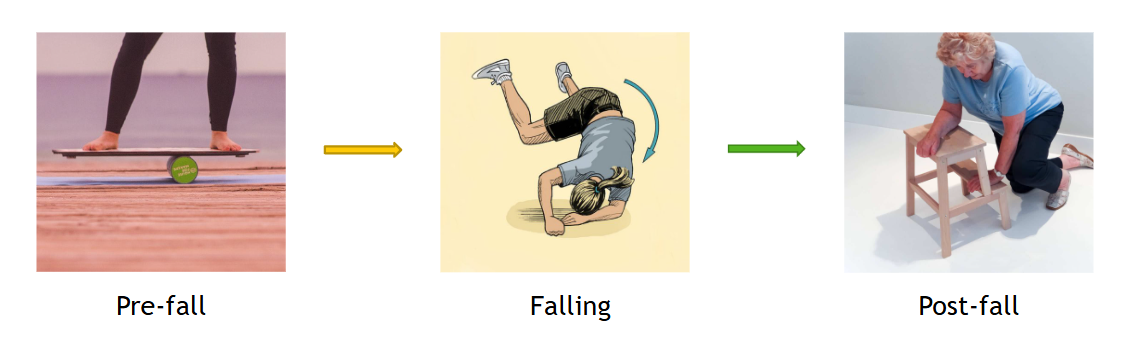
The Falling Continuum is a framework that describes a fall as a process with three interconnected phases:
Pre-Fall – everything that happens while you’re still on your feet
Falling – what occurs once balance is lost and the body is moving toward the ground
Ground Recovery – everything that happens after you come to rest on the ground
Each phase contains skills that can be trained, strengthened, and improved. And weakness in any one phase increases overall risk, even if the other phases are well developed. This framework is the lynchpin behind Science of Falling and sits at the heart of every article, video, and talk I create.
Falls Are Failures of Systems, Not Accidents
Falls are often treated as random accidents. But “accident” implies unpredictability. In reality, most falls follow recognizable patterns.
Balance capacity declines. Reaction time slows. Strength and muscle mass decrease. Environmental challenges increase. Eventually, something exceeds the body’s ability to respond. Then, BAM! You’re looking up at the sky wondering what just happened.
When fall prevention focuses only on avoiding the fall itself, it assumes a perfect world, one where balance is always recoverable and external forces are forgiving. The Falling Continuum accepts reality instead. It acknowledges that while some falls can be prevented, others must be managed, and still others must be recovered from safely.
Effective fall safety requires addressing the entire system, not just the first link in the chain.
Pre-Fall: Everything That Happens While You’re Still Upright

The Pre-Fall phase includes everything that occurs before a fall begins. This is the phase most people are familiar with, and for good reason: improving pre-fall capacity can stop many falls from happening at all.
However, pre-fall training is often oversimplified as “having good balance” and overly weighted in training or rehab programs.
In the real world, balance is dynamic and reactive. It’s shaped by how quickly and effectively your body responds to unexpected challenges like trips, slips, sudden turns, uneven ground, distractions, or external forces.
Pre-fall capacity includes:
Balance ability across changing conditions
Stepping reactions that reposition the base of support
Use of ankle, hip, and whole-body motor strategies
Strength and robustness developed through resistance training
Strength plays a critical role here. Stronger muscles allow for faster, more forceful corrective steps and give the body more options when balance is threatened. Pre-fall training is not about avoiding movement, it’s about responding well when movement becomes chaotic.
High pre-fall capacity can prevent many falls outright. But no amount of balance training guarantees that balance will always be saved.
When recovery strategies are overwhelmed, the continuum moves forward.
Check out these articles and videos to dive deeper into pre-fall skills:
Falling: Managing the Moment Balance Is Lost
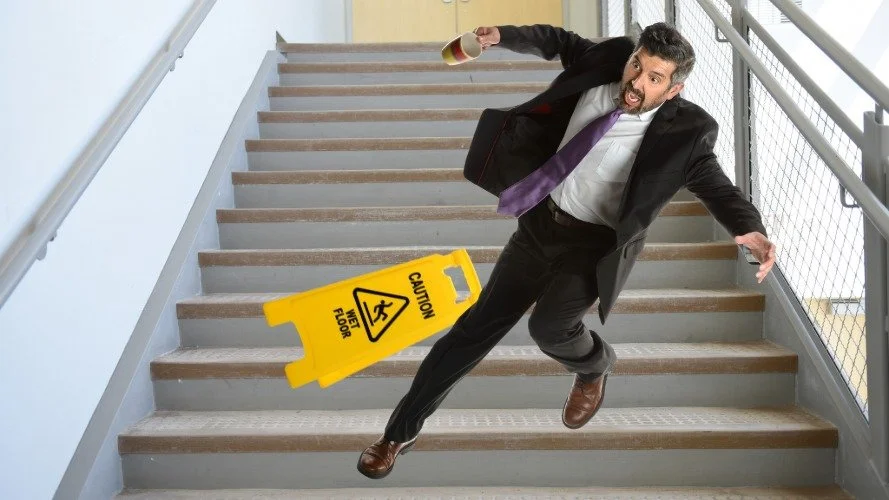
The instant balance can no longer be recovered, the body enters the Falling phase. This is the phase most associated with fear, most associated with injury, and the most avoided entirely.
Traditional fall prevention often ends here conceptually, as if nothing useful can be done once a fall begins. But this ignores a crucial reality, how you fall matters.
The falling phase is about how force and momentum move through the body. When falling skills are absent, impact forces concentrate in vulnerable areas such as the wrists, hips, spine, or head. When falling skills are present, those same forces can be redirected, absorbed, and dispersed more safely.
This phase focuses on learning how to:
Absorb force gradually instead of abruptly
Redirect momentum rather than resist it
Protect high-risk joints and structures
Move as an integrated, coordinated system
This is where the ROLL SAFE framework and specific falling techniques come into play, including forward and backward rolls, sideways and barrel rolls, butt falls, and proper vertical landing mechanics. These skills are trained progressively and intentionally, similar to methods used in martial arts, gymnastics, and athletic development.
The goal is not to make falling “entirely safe.” The goal is to make it safer and more manageable.
Ignoring this phase leaves people unprepared for one of the most injury-prone moments in human movement.
Check out these articles and videos to dive deeper into falling skills:
Ground Recovery: What Happens After the Fall

The Falling Continuum does not end when motion stops. In many cases, the Ground Recovery phase determines the severity of outcomes more than the fall itself.
Once on the ground, several things happen at once. A person must assess injury, regulate fear, and make decisions under stress. Can they move? Can they breathe normally? Are they injured? Do they know how to get up safely?
Ground recovery involves:
Injury awareness and self-assessment
Maintaining composure and controlled breathing
Problem-solving movement options from the floor
Having the strength and technique to execute a safe floor-to-stand transition
Time on the ground matters. The longer someone remains down after a fall, the more complications can arise, especially for individuals who live alone. While uncomfortable to think about, many serious outcomes occur not because of the fall itself, but because of what happens afterward.
Training ground recovery skills reduces panic, shortens time on the floor, and increases the likelihood of a controlled, safe outcome.
Check out these articles and videos to dive deeper into ground recovery skills:
The Falling Continuum as a Self-Diagnostic Tool
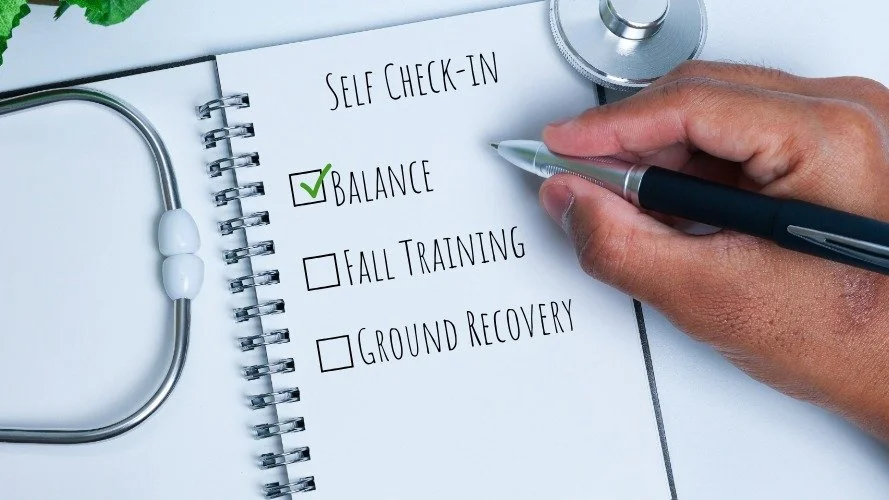
One of the most powerful aspects of the Falling Continuum is how clearly it exposes blind spots.
Many people train balance but never practice getting up from the ground. Others are strong and mobile but have never learned how to fall safely. Some avoid thinking about falls altogether, leaving all three phases unaddressed.
Viewing fall safety through this framework allows you to ask better questions:
Which phase do I train regularly?
Which phase do I ignore or avoid?
Where would I struggle most if something went wrong?
These “chinks in the fall-safety armor” are rarely obvious until the entire continuum is considered. But, once it is considered, most people I talk to have a fairly accurate gut instinct of where there deficiencies lie.
Final Thoughts: Why the Falling Continuum Matters

Fall prevention is not a single skill, but rather a culmination of skills in three different areas: pre-fall, falling, post-fall.
When all three phases of the Falling Continuum are addressed:
Fewer falls occur
Injuries are less severe when falls happen
Recovery is faster and more controlled
Confidence increases
Independence is preserved longer
The Falling Continuum does not promote fear or pessimism. It promotes preparedness, realism, and capability. It makes you question your own ability in all necessary areas.
A fall does not begin when you hit the ground, and it does not end when you stop moving. By understanding and training across the full continuum (pre-fall, falling, and ground recovery) we can approach fall prevention and safety in a way that reflects how the body actually moves through the world.
And when we train for reality, we are far better equipped to live within it. Understanding the Falling Continuum doesn’t make you fragile, it makes you capable.
What’s Your Fall Risk Score?
Most people don’t notice their balance declining until something goes wrong.
This 10-minute self-assessment will show you:
• How stable your balance really is
• Where you're most at risk (strength, coordination, or falling ability)
• What to focus on first
No equipment. No guesswork. Just clear answers.