
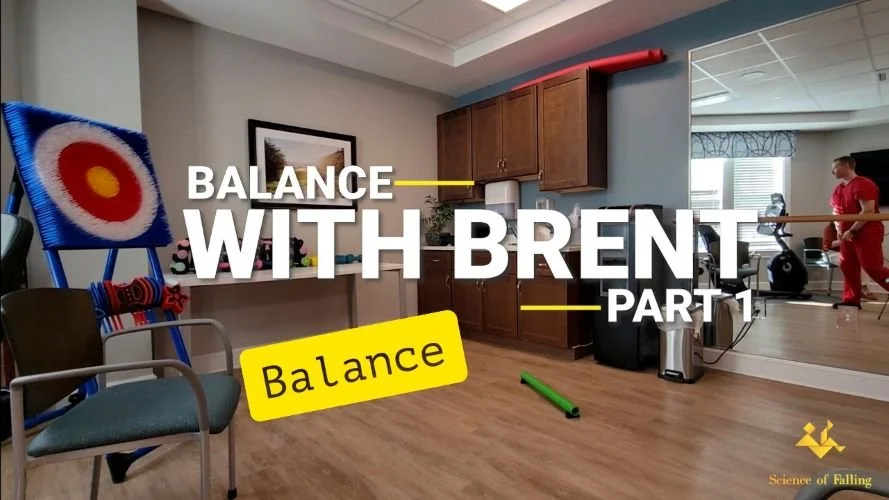
Balance With Brent Part 1: Balance (Pre-Fall)
Updated: 5.16.26
Balance With Brent is a 3-part presentation series I delivered at Stone Hill an assisted living facility in Andover, MA in December 2025. Each talk explores a different stage of the falling continuum:
Part 1: Pre-Fall (Balance)
Part 3: Post-Fall (Ground Recovery / Getting Off the Ground)
These presentations were intentionally unrehearsed, with only the topic of the day prepared. This allowed for real-time audience questions, discussion, and participation, making each session interactive and responsive to the group.
The first talk focused on balance. I discussed the major systems that contribute to balance, how I assess balance in real life (not just in clinical tests), practical ways to train and improve balance, and the many subtle ways balance problems can show up during everyday activities, often long before an actual fall occurs.
Key Takeaways From This Balance Session
What is balance really?
Balance is the brain’s ability to combine vision, foot sensation, and inner ear input to keep you upright in real time.
Why do people lose balance?
Most issues come from one or more systems being reduced:
vision changes
reduced foot sensation
inner ear dysfunction
brain integration issues
Why do people veer when walking?
Veering usually reflects asymmetry between left and right leg stability, especially when walking slowly or when single-leg stance time increases.
What makes balance worse in real life?
slowing down walking speed
removing vision (dark rooms, eyes closed)
uneven strength between legs
fear of falling and stiff movement
How the Body Controls Balance
Vision system: Your eyes help define level, orientation, and spatial reference points in the environment.
Proprioception (feet & joints): Sensors in your feet and joints detect pressure, load, and movement direction.
Vestibular system: The inner ear system detects head movement, rotation, and acceleration. Vestibular System
Brain integration: The brain constantly weighs all three systems and adjusts muscle activation to prevent a fall.
Common Medical Causes of Balance Problems
Neuropathy: Loss of sensation in the feet reduces ground feedback and increases fall risk. Neuropathy
Vertigo and BPPV: Inner ear crystal displacement can cause spinning sensations and sudden instability. BPPV (Benign Paroxysmal Positional Vertigo)
Vision loss: Reduced visual input forces the brain to rely more heavily on weaker systems.
Neurological conditions: Brain-level processing issues reduce the ability to integrate sensory information effectively.
Why Walking Speed Changes Balance
Fast walking
uses constant “fall and catch” cycles
masks instability through momentum
reduces time spent in single-leg stance
Slow walking
increases time on one leg
exposes weakness between sides
makes veering more noticeable
What the Balance Tests Reveal
Standard standing: Tests baseline stability with feet apart.
Narrow stance: Reduces base of support and increases demand on control systems.
Eyes closed: Removes visual input and exposes sensory dependence.
Head turns: Challenges vestibular system processing.
Heel-to-toe stance: Simulates walking alignment and increases difficulty.
Single-leg stance: Maximum challenge to integrated balance control.
Why Hip Strength Is Critical for Balance
Key muscle: gluteus medius
Controls pelvic stability during single-leg stance.
Weakness signs:
hip drop
side-to-side sway
excessive corrective stepping
Simple training options:
lateral band walks
side stepping along a counter
controlled leg lifts
Why People Fall (and How the Body Responds)
Loss of balance - The brain detects instability.
Stepping reaction - The body automatically tries to catch itself.
Recovery or fall- Success depends on speed, strength, and available stepping options.
Key insight: Most injuries happen when stepping reactions are too slow or not trained.
The Missing Link in Fall Prevention
Traditional focus:
avoid falling
improve strength
improve walking
Missing component: Training how to fall and recover during a fall
Why it matters: Without practice, the body defaults to inefficient reactions under stress.
Fear and Balance Performance
What fear does:
increases stiffness
reduces reaction speed
limits natural corrective movement
What improves balance:
perceived safety (rails, light touch, support nearby)
gradual exposure to instability
repeated successful recovery experiences
Footwear and Balance Sensitivity
Cushioned shoes:
reduce ground feedback
decrease foot muscle activation
increase reliance on vision
Barefoot/minimal exposure:
increases sensory input
strengthens foot stabilizers
improves proprioception over time
(Progression matters for safety and fall risk.)
Bottom Line: What Balance Training Actually Does
Balance training is not about eliminating wobble.
It is about improving:
detection of imbalance
speed of correction
quality of stepping reactions
confidence under instability
The goal is not perfect stillness, it is reliable recovery from instability.
This approach is central to the system used in Science of Falling, where balance, stepping, and falling are treated as one continuous skill set rather than separate abilities.