
Balance With Brent Part 2: Falling
Updated: 5.16.26
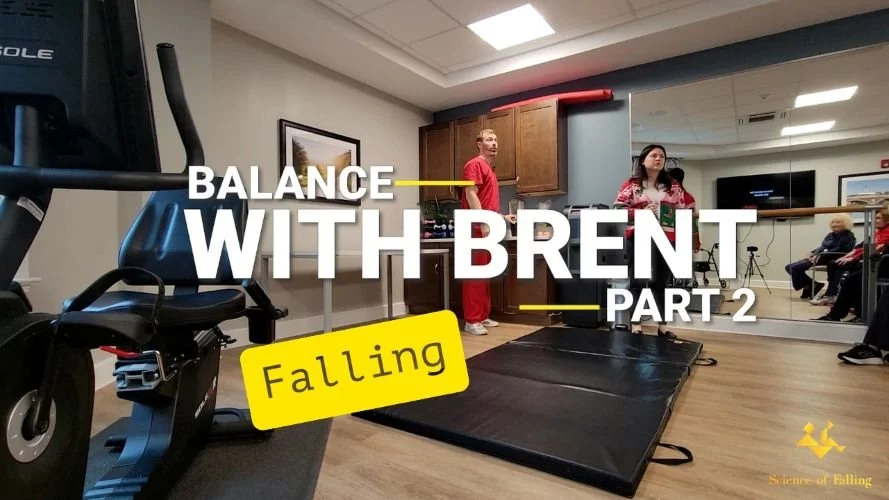
Balance With Brent is a 3-part presentation series I delivered at Stone Hill an assisted living facility in Andover, MA in December 2025. Each talk explores a different stage of the falling continuum:
Part 2: Falling
Part 3: Post-Fall (Ground Recovery / Getting Off the Ground)
These presentations were intentionally unrehearsed, with only the topic of the day prepared. This allowed for real-time audience questions, discussion, and participation, making each session interactive and responsive to the group.
The second presentation focused on falling itself, a topic that is both critically important and widely overlooked in health and healthcare settings.
This talk marked the first time I publicly introduced my ROLL SAFE Framework, which led to a slightly clunky but honest and exploratory start as I worked through the ideas in real time with the audience. From there, I covered the core principles of falling, common fall scenarios, and specific falling techniques designed to reduce injury risk.
I also discussed how people can begin learning and practicing fall skills even when full physical practice isn’t possible, as well as why learning how to fall is just as important as trying to prevent falls altogether. The presentation emphasized the reality that falls will happen, and that preparing for them is a vital, but often ignored, part of lifelong movement health.
Key Takeaways From This Falling Session
Safe Falling Principles (ROLL SAFE System)
This section breaks down the key ideas from the video: simple, universal principles for how to fall safely and reduce injury risk in real-world situations.
Instead of memorizing complex techniques, the goal is to understand a few core principles that work in almost any fall scenario: forward, backward, sideways, or unexpected slips.
RELAX the Body When Falling
When people fall, the instinct is to tense up. That’s one of the biggest causes of injury.
Tension turns your body into a rigid object, meaning more force gets transferred directly into bones and joints (like wrists, shoulders, or collarbones).
A better approach is controlled relaxation:
Keep joints loose instead of locked
Allow the body to “give” on impact
Think of the body more like a spring than a plank
Even in extreme cases, people who are unconscious or relaxed during a fall can sometimes sustain fewer injuries than those who stiffen up.
OBSERVE Your Surroundings Mid-Fall
If a fall happens, your environment matters just as much as your body position.
Try to notice:
Objects on the ground (weights, furniture, tools)
Sharp edges or corners
Hard vs soft landing areas
Whenever possible, guide your fall toward a safer landing zone. Even small adjustments can prevent direct impact with dangerous objects.
LENGTHEN the Fall (Reduce Impact Force)
Most injuries happen because impact occurs all at once.
The goal is to spread force over time.
Instead of a sudden stop:
Rolling distributes impact across multiple body parts
Slowing descent reduces peak force on any single joint
Even a simple sideways “tuck and roll” can help
Think: less “slam,” more “flow.”
SHIELD the Head (Top Priority)
Head protection is always the priority in any fall.
Why:
Head impacts can lead to concussion or brain injury
Severe head trauma can be life-changing or life-threatening
Other injuries (like wrist or hip injuries) are serious, but less critical
If you can protect only one thing in a fall, protect the head by:
Tucking the chin
Turning away from impact
Using arms to create a buffer zone
AFE: ABSORB • FLOW • EXHALE
This principle is about what to do in the moment of impact.
Instead of fighting the fall:
Absorb: Let joints bend to reduce force
Flow: Move with the direction of momentum instead of against it
Exhale: Exhaling reduces tension and helps the body stay loose
Holding your breath or resisting impact increases stiffness, and stiffness increases injury risk.
Go with the Fall (Don’t Fight Momentum)
One of the most important ideas: Once you’re falling, momentum is already decided.
Trying to stop or redirect it usually increases injury risk.
Instead:
Work with your direction of motion
Use controlled rolling when appropriate
Adjust only to avoid obstacles, not to “fight gravity”
Why This Matters (Especially with Age)
Balance and reaction speed naturally decline over time, often starting around midlife. That means:
Falls become more likely
Recovery becomes harder
Injury risk increases
This is why learning falling principles—not just balance—is so important for long-term mobility and independence.
Mental Training: The Missing Piece
You don’t need to physically practice falling to improve safety.
A powerful alternative is mental rehearsal:
Replay past falls in your mind
Visualize better responses (relaxing, rolling, protecting the head)
Run “what if I slipped here?” scenarios for a few minutes daily
This helps build automatic protective responses before a real fall ever happens.
Key Takeaway
You don’t need perfect technique to fall safely.
You need:
Relaxation instead of tension
Awareness instead of panic
Flow instead of resistance
Head protection above everything
Even one of these principles can significantly reduce injury risk in a real fall.