
The Cure for Fear of Falling Isn't Courage, It's Preparation

This Article is part of the SoF Quick Read Series: Trimmed-down, real-life strategy guides for handling everyday balance moments. Lighter reads. Still grounded in science. Always worth your time, and linked to deeper articles for when the itch to learn arises.
Essential Points:
Fear is often a signal, not the problem. Instead of trying to "be brave," ask what your fear is revealing. Fear of falling usually points to a lack of preparation or confidence, not a lack of courage.
Confidence is built through evidence, not positive thinking. Every successful repetition, whether it's improving balance, practicing getting up from the floor, or strengthening your body, gives your brain proof that you can handle future challenges.
Preparation creates freedom. You can't eliminate the risk of falling, but you can dramatically improve your ability to respond. By building capability through practice, you reduce fear, regain independence, and stay engaged in the life you want to live.
Prefer to listen? Here’s a quick audio breakdown with a few extra insights:
I've done my fair share of hard things in life.
Most of them have been by choice. Somewhere along the way, I developed a fascination with seeing how far I could push myself, both mentally and physically. That curiosity has led me to move across the country, speak at conferences, run ultramarathons, and spend far too many weekends covered in mud at Spartan Races.
If you've never heard of one, imagine trail running combined with an obstacle course. You spend miles climbing hills, carrying heavy objects, crawling under barbed wire, scaling walls, and occasionally wading through water. They're physically demanding, mentally exhausting, and, if you're anything like me, incredibly fun.
Over the years, I've completed somewhere around thirteen or fourteen of them. Most of the water obstacles weren't really swimming. They were shallow ponds or muddy streams where you could simply wade across.
That was fortunate.
Because I have a confession to make…I can't swim. Don't go sharing that on the internet or anything, please.
For years, I assumed that meant I was simply afraid of water. But now, I think it meant something else entirely.
A few years ago, I was racing at a ski resort in the middle of summer. After exhausting myself climbing one of the steepest hills on the course, I rounded a corner expecting another obstacle.
Instead, I found a pond.
Suspended over the middle was a thick rope with a bell hanging from its center. Competitors climbed out across the rope upside down, rang the bell, dropped into the water, and swam about one hundred feet to shore. A few kayakers floated nearby in case anyone needed help.
I immediately slowed to a walk and surveyed my situation.
There was no rope stretched across the water to hold on to for non-swimmers. No safe shallow crossing. Just a life jacket, a deep breath, and a decision to make to make.
For a moment, I considered taking the penalty instead of attempting the obstacle. The penalty for skipping an obstacle was twenty burpees, and suddenly that sounded like a fantastic deal. After all, I couldn't swim. Objectively speaking, voluntarily jumping into a pond was probably the worst decision available.
But after nearly an hour of racing, fueled by adrenaline and probably a little too much confidence, I convinced myself I could do it.
I quietly told the volunteer, "I'm a terrible swimmer." Then I strapped on the life jacket and started climbing.
Every movement demanded complete focus. My legs hooked over the rope, my hands squeezed as tightly as they could, and inch by inch I worked my way toward the bell.
Then my grip began to fail.
For the first time that day, I wasn't thinking about finishing the race. I was thinking about what was about to happen next. A few seconds later, I hit the water.
At first, everything seemed fine. The life jacket pulled me back to the surface exactly as it was designed to do.
Then I tried to swim.
My strokes were terrible. My face kept dipping beneath the surface. I swallowed several mouthfuls of murky pond water and felt the unmistakable realization that accompanies real fear.
I wasn't prepared for this.
I could have kept struggling. Instead, I waved down one of the kayakers and admitted I needed help.
After collecting what little remained of my pride, I accepted my twenty-burpee penalty for failing the obstacle and finished the remaining three laps of the race. Every time I reached that pond, I happily chose the burpees instead.
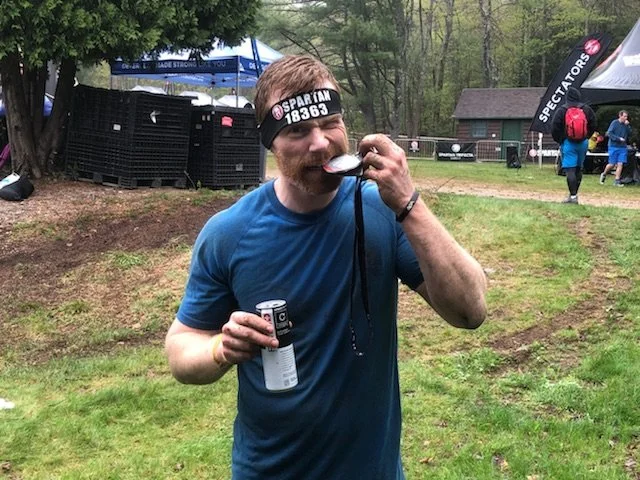
Me with a cheeky end of race celebration, clearly still alive and breathing!
For a long time, I thought the lesson from that day was about courage. I thought I'd failed because I wasn't brave enough to push through and make an ugly swim to shore.
I was wrong, I didn't need more courage. I needed more preparation.
The life jacket reduced the consequences of making a mistake, but it couldn't give me the one thing my brain knew I was missing, the ability to swim.
Looking back, I realized fear had been trying to teach me something all along. It wasn't telling me to avoid water forever. It wasn't telling me I was permanently weak or incapable. It was telling me I wasn't ready.
See, fear wasn't the problem, but rather my lack of skill was.
That realization completely changed the way I think about fear, not just fear of swimming, but fear itself. And in doing so, it has helped me guide so many of my patient’s away from their dreaded fear of falling.
What If Fear Isn't the Enemy?
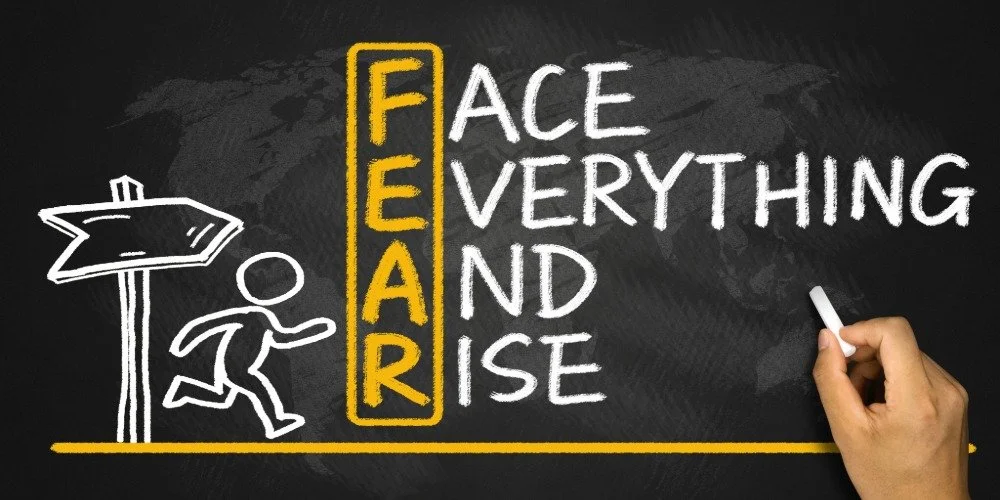
We've all heard the advice:
"Face your fears."
"Just be brave."
There's certainly some truth in those ideas. Growth often requires stepping outside your comfort zone, and avoiding every uncomfortable situation isn't a recipe for a fulfilling life.
But I wonder if we sometimes misunderstand what fear is trying to tell us. What if fear isn't the obstacle? What if it's trying to tell us something important?
Looking back, that's exactly what happened to me in that pond.
For years I thought I was afraid of water. I wasn't. I was afraid of being in deep water without knowing how to swim. Those are two very different fears.
One says the world is dangerous. The other says, "You’re not prepared for this yet."
That's an important distinction.
Fear isn't always irrational. In fact, sometimes it's remarkably honest. Sometimes it's our brain saying, "You haven't given me enough evidence that we can handle this."
That doesn't mean fear is always right. Our brains can certainly overestimate danger, especially after a traumatic experience or long periods of inactivity. But before we dismiss fear as something to conquer, it's worth asking a different question:
What is it trying to teach me?
When we choose to listen, fear can become one of our greatest teachers. It reveals where our current limits are, and it tells us where we have work to do.
The mistake isn't feeling afraid. The mistake is ignoring what fear is trying to teach us.
Your Brain Doesn't Like Uncertainty
In my opinion, one of the coolest things about the human brain is its ability to imagine the future.
Long before anything actually happens, we can picture hundreds of possible outcomes. We mentally rehearse conversations before they occur. We imagine how tomorrow's presentation might go. We think about every possible consequence before making an important decision.
That ability has helped humans survive and thrive our entire history.
It has also given us the unfortunate ability to worry and think about potential bad outcomes for years, months, or even moments before a major event.
Think about if you’re waiting outside the operating room before surgery. Standing backstage before giving a speech. Clicking the seatbelt into place just before a roller coaster begins its climb. Or taking those first tentative steps after recovering from a serious fall.
The anticipation is often worse than the event itself.
Why though?
Because before the moment arrives, our minds are juggling dozens, or even hundreds, of possible futures:
What if I fall?
What if I embarrass myself?
What if I can't get back up?
What if something goes terribly wrong?
Then something interesting happens. The moment arrives. Those hundreds of imagined futures suddenly collapse into one reality and now there's only one situation in front of us. Our brain no longer has to imagine every possibility, instead it simply has to respond.
Preparation makes that response much easier.
Every time we practice a skill, our brain gains another piece of evidence that says, "I've been here before." The unknown becomes familiar. The unfamiliar becomes routine.
Fear begins to lose its grip, not because the challenge disappeared, but because uncertainty did.
The Hardest Thing You've Ever Done
There's a saying I've always liked:
The hardest thing you've ever done, is the hardest thing you've ever done.
I have no idea who first said it, but I think there's a lot of truth jam-packed into that simple sentence.
Our brains don't compare today's challenge to someone else's life. They compare it to our own experiences.
If you're five years old, the hardest thing you've ever done might be sitting through a four-hour car ride. If you've never exercised before, walking a mile may feel overwhelming. If you've spent years running marathons, that same mile barely registers.
Neither person is wrong, they're simply using different rulers to measure the challenge in front of them.
That's one of the reasons I intentionally seek out difficult experiences. I don't do them because suffering is inherently valuable. I do them because every hard thing expands my understanding of what I'm capable of.
It recalibrates my internal ruler. Every challenge I encounter still feels difficult, but it no longer feels impossible.
I ran 9 miles just this morning in 96-degree heat. I ran out of water on mile 6, my left achilles started to ache, and I was insanely uncomfortable with how much I was sweating. But I’ve run 32 miles in mid-July, on my 32nd birthday, a few years ago. I’ve built a different definition of hard, and this was low on the scale.
Fear often works the same way. Everything is scary the first time, and everything feels impossible until it isn't.
The wonderful thing about experience is that it slowly changes the conversation inside your own mind. Challenges that once seemed overwhelming begin to feel manageable because you've accumulated proof that you can handle difficult things.
That's not blind optimism, that's confidence.
And confidence is something we'll explore next.
Confidence Comes From Evidence
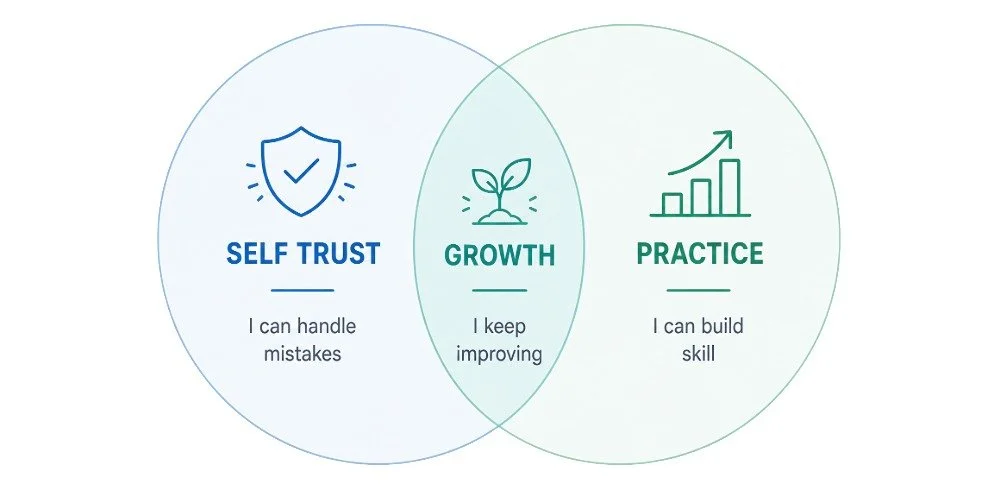
When I look back at that Spartan race, I realize my biggest mistake wasn't attempting the obstacle. It was believing I was more prepared than I actually was.
That's the difference between confidence and overconfidence.
Overconfidence ignores the evidence. Real confidence is built from it.
Think about almost any profession or hobby that most people consider scary.
A firefighter doesn't walk into a burning building because they're fearless. They spend countless hours training, learning their equipment, and practicing emergency scenarios until many of their responses become second nature.
Commercial airline pilots don't calmly land airplanes in crosswinds because they were born confident. They earn that confidence through hundreds, often thousands, of hours in the cockpit and simulator.
Even something as simple as public speaking follows the same pattern. Nobody wakes up one morning completely comfortable speaking to hundreds of people. Confidence comes after dozens of awkward presentations, forgotten lines, shaky voices, and lessons learned along the way.
The common thread isn't bravery, rather it's repeated exposure and practice.
Every successful repetition teaches the brain, "I've done something like this before."
Psychologists call this self-efficacy, the belief that you can successfully perform a task. (1) One of the strongest ways we build that belief isn't through positive thinking or motivational speeches. It's through repeated success. Every time we accomplish something difficult, our brain quietly updates its prediction about what we're capable of doing.
In other words, confidence isn't something we find.
It's something we build.
Fear of Falling Is Often a Confidence Problem
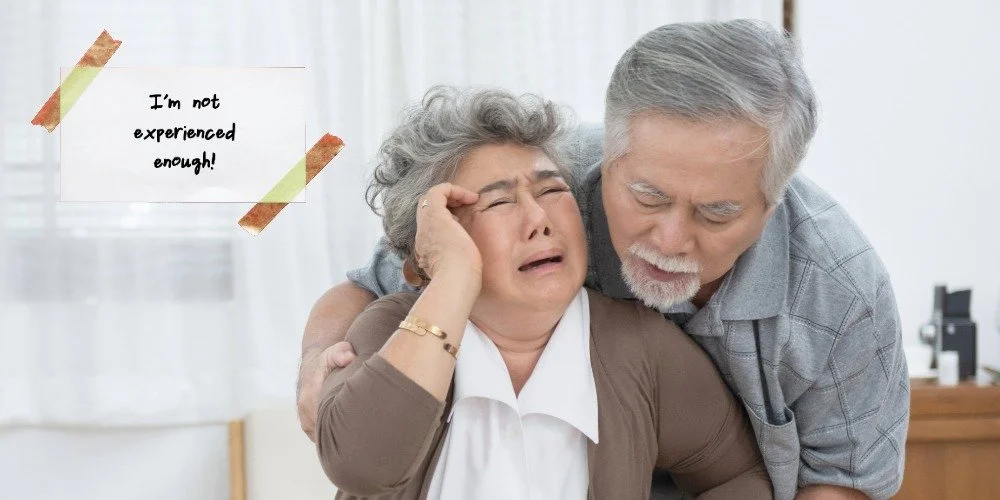
So, what does any of this have to do with falling?
Well…everything, really.
One of the biggest misconceptions about fear of falling is that people are afraid of gravity. They're not. They're afraid of what happens after gravity wins:
What if I break my hip?
What if I can't get up?
What if no one finds me?
What if it happens again?
Those aren't fears of falling, they're fears of helplessness, pain, uncertainty. That's an important distinction because it changes where we should focus our attention.
Instead of asking, "How do I stop being afraid?"
Maybe we should be asking, "How do I become more prepared?"
One Patient Changed the Way I Think About Fear

Not long ago, I worked with a patient who had broken her femur after a fall.
Before her injury, she walked independently around her home, although she often steadied herself against furniture and walls without thinking much about it. Like many people, she had convinced herself she was getting by just fine.
Then one bad day changed everything:
Surgery
Rehabilitation
Months of recovery
By the time she came to me, she had regained enough strength to begin outpatient therapy, but something else had been lost.
Her confidence.
In my job, I often tell people that I'm usually the last physical therapist they'll see (and in my setting of PT, I quite literally am). My job isn't simply to help someone recover from surgery. It's to help them return to the life they want to live, and if possible, help them discover they're capable of even more than they thought.
From our very first session, her fear was obvious. The idea of walking without her walker felt impossible. The thought of returning to the level she had been before her fall seemed unrealistic. Every new exercise came with hesitation and doubt. Every challenge I gave her was met with the same question, "What if I fall again?"
Honestly, I couldn't blame her.
If the last six months of your life had been filled with pain, surgery, and uncertainty because of one fall, your brain would probably reach the same conclusion.
But as we worked together, something else became clear. Her fear wasn't appearing out of nowhere.
She had neuropathy in both feet. Her balance had been declining for years, although she was great at compensating. She admitted she had always held onto walls while walking through her home. Yet despite those warning signs, she had never practiced balance training. She had never worked on recovery strategies. She had never prepared for the challenge that eventually arrived.
Her fear wasn't lying to her, it was telling the truth. Her balance wasn’t great and she wasn’t ready for a fall.
The good news? Readiness levels can change.
We didn't begin by taking away her walker. We didn't tell her to, "just believe in yourself." And I certainly didn't ask her to ignore her fear.
Instead, we started exactly where she was.
One exercise. One successful repetition. One small victory at a time.
Week after week, those victories accumulated. She became stronger, more balanced, quicker in her reaction time. She started collecting wins, evidence of her new emerging ability.
About a month later, she walked nearly 300 feet without holding onto anything. No walker, no hand hold, just herself and a good hint of confidence.
The reality is, she still had hesitation, but she showed herself that she was capable. She had personal experience that she could do it. Her brain no longer had to imagine hundreds of disastrous possibilities because she'd already proven, to herself, that she could succeed.
That's what preparation does. It doesn't eliminate every risk, it simply gives fear fewer reasons to exist.
So How Do We Prepare?
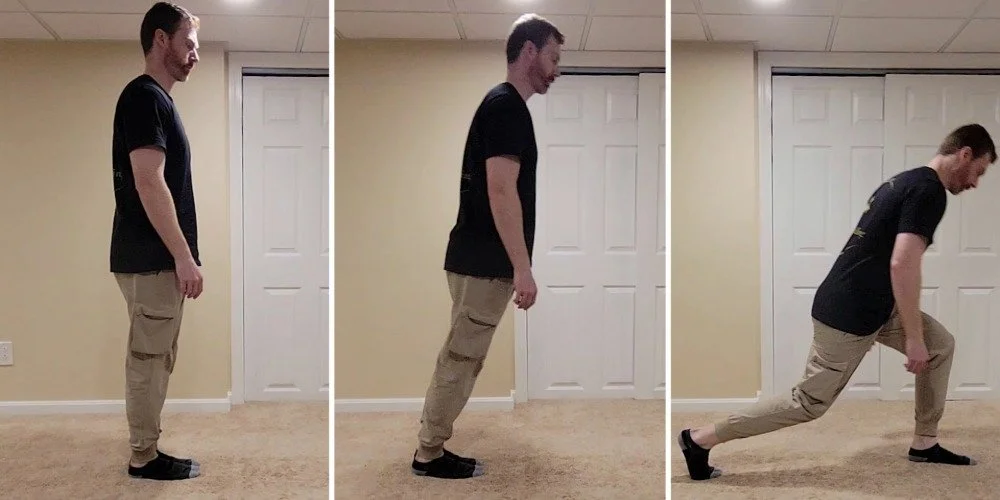
Exercise from the Master Your Fall program - Forward Stepping Reaction
At this point you might be thinking, "That all sounds great, but how do I actually prepare for something like falling?"
Ironically, fear already gave you the answer. Remember what I mentioned earlier? Fear is information.
It tells us what needs work. It just doesn't tell us how to work on it. That's where practice begins.
One of the things I tell nearly every patient is that physical therapy really isn't as complicated as people think. Yes, I spent years in school learning anatomy, neuroscience, biomechanics, and rehabilitation. But when you strip all of that away, my job comes down to one simple idea.
Figure out what you want to do that you can't do today. Then find the closest version of that activity you can do safely, and start there.
That's it. Don’t avoid the challenge, instead meet it where you are today.
If you're afraid of getting up from the floor, we don't begin by throwing you onto the ground and hoping for the best. We build into it.
If you're afraid of walking outside because of uneven sidewalks, we don't immediately send you hiking through the woods.
We begin by:
Standing from a chair
Then shifting your weight
Then walking across a flat floor
Then walking outside
Then navigating curbs
Each step builds on the one before it.
Skill development isn't glamorous, matter of fact, it's often repetitive and extremely boring. It can be tediously slow at times to the point of frustration for many of my patients.
But that's exactly how confidence is built. One successful exercise and repetition at a time.
Preparation Changes More Than Your Body
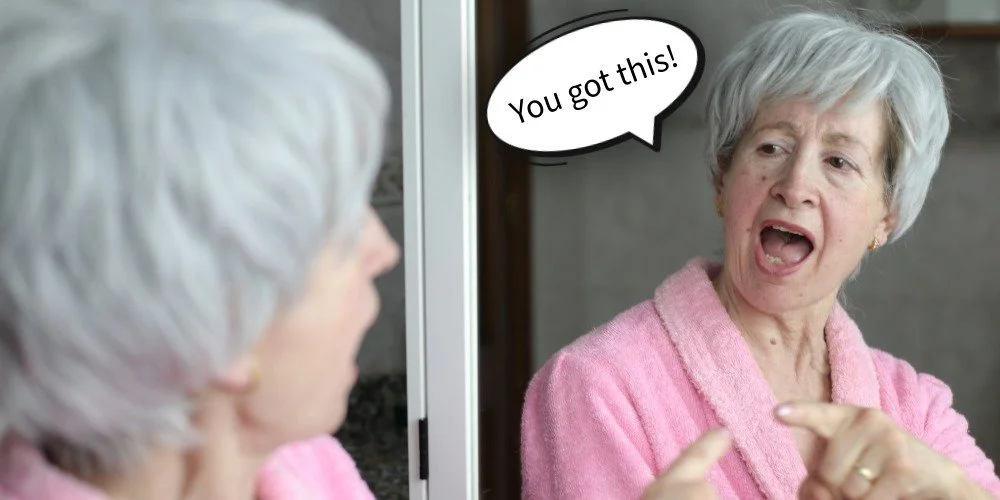
Most people think balance training is about stronger legs, better coordination, and preventing falls. And while those things are all true, I think something even more important is happening.
Preparation changes the story you tell yourself while you build the physical skills.
When fear is in control, your inner dialogue sounds something like this:
"I hope I don't fall."
"Maybe I shouldn't go."
"I'm probably safer staying home."
Those thoughts slowly shrink your world. You lose the life you once loved, the connections that gave you joy, and the dreams of future adventures that make life worth living.
Life becomes smaller, not because your body demanded it, but because fear did. Your body just followed along and got weaker and less capable along the way.
Preparation slowly rewrites that story.
Instead of hoping you won't fall, you begin trusting yourself if you do:
"I've practiced this."
"I know how to recover."
"I know how to get back up."
That doesn't make you reckless, it just makes you capable.
There's a tremendous psychological difference between avoiding life because something might happen and participating in life because you know you're prepared if it does.
Capability Is Freedom

One of the greatest tragedies with a fear of falling isn't the fear itself.
It's everything people give up because of it. The walks they stop taking, the vacations they never book, the grocery store they avoid, the wedding the choose not to attend, the hobbies they quietly abandon, the grandchildren they watch from a chair instead of the floor.
Fear has a way of making our world smaller. Competence has a way of giving it back.
I've watched it happen countless times in my day-to-day work.
Someone who initially refused to let go of a walker eventually walks independently. Someone who wouldn't step onto grass begins hiking again. Someone who was terrified of getting onto the floor ends up playing with their grandchildren without a second thought.
Those changes don't happen because people suddenly become fearless.
They happen because they become prepared, the dissipation of fear is just a side-effect.
Final Thoughts: Capability Over Courage

I still think about that pond from the Spartan Race. For years I believed my biggest weakness was fear, but it wasn’t. My biggest weakness was pretending I could skip the preparation.
Fear had been trying to tell me something all along, "Learn how to swim you dummy."
I simply wasn't listening.
Funny enough, becoming a father has changed the way I think about that experience. Learning to swim is no longer just another item on my bucket list. It's a responsibility. If my son ever needed me in the water, I want preparedness, not panic, to dictate what happens next.
I’d jump in whether I can swim or not, but in one scenario we both survive, in the other…well I’d rather not think about it.
The same principle applies to falling.
When we're young, learning how to balance, recover from a stumble, or get up from the floor feels optional. Those skills seem reserved for martial artists, athletes, or people who enjoy extreme sports. Most of us already possess the bare minimum ability to keep ourselves safe anyway.
As we age, they become something else entirely.
They become preparation for a challenge that almost all of us will eventually face. None of us can eliminate gravity. None of us can guarantee we'll never fall, and I am certain all of us will eventually.
But we can prepare. We can prepare our body and mind to be ready for a fall. We can strengthen our bodies, improve our balance, sharpen our reflexes, master being on the floor, and learn how to respond when a fall happens.
Every one of those actions builds evidence, and that evidence builds confidence. And every bit of confidence gives fear one less reason to exist.
The opposite of fear isn't courage.
It's capability.
What’s Your Fall Risk Score?
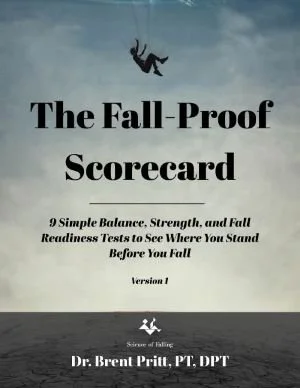
Most people don’t notice their balance declining until something goes wrong.
This 10-minute self-assessment will show you:
• How stable your balance really is
• Where you're most at risk (strength, coordination, or falling ability)
• What to focus on first
No equipment. No guesswork. Just clear answers.
References
Bandura, A. (1977). Self-efficacy: Toward a unifying theory of behavioral change. Psychological Review, 84(2), 191–215. https://doi.org/10.1037/0033-295x.84.2.191