
The Psychology of Feeling Invincible: Why Feeling Steady Doesn’t Mean You Have Good Balance
Essential Points:
Confidence and competence are not the same. You may feel steady based on past ability, but true balance depends on measurable physical skills that change gradually with age.
Both overconfidence and underconfidence increase fall risk. Misjudging your abilities, either by taking risks beyond your capacity or avoiding movement out of fear, can quietly lead to declining balance and higher fall potential.
Balance is a trainable skill at any age. Regular testing, strength and sensory challenges, and intentional practice can realign confidence with real ability, helping you move with stability, independence, and resilience.
Prefer to listen? Here’s a quick breakdown with a few extra insights.
“I don’t need any help, my balance is great. I can walk, see?”
I hear some variation of this almost every day at work. Honestly, if I had a dollar for every time someone said it, I could probably fund an entire website about falling.
I watch people walk confidently down assisted-living hallways, one hand lightly grazing the wall for “just a little extra stability.” They haven’t fallen yet, so in their mind, everything is fine. But if you look closely, the widened stance, the shortened steps, the subtle “furniture surfing”, a different story appears.
That confidence is often built on memories of how their body used to move, not how it moves today.
Most of us grow up never thinking about balance as a skill. Walking feels automatic. Standing feels effortless. Your body simply knows what to do.
And for decades, it does.
When you’re young, your balance systems operate quietly in the background. Muscles react quickly, your inner ear provides precise motion signals, your joints send clear position information, and your brain integrates it all without conscious effort. This is automatic postural control in action, requiring minimal conscious attention in healthy adults (1, 2)
But aging doesn’t announce itself dramatically. Balance changes slowly and silently.
Sensory receptors become less sensitive, reaction times lengthen, and strength and coordination decline subtly year by year as we age. (3, 4, 5) The nervous system adapts remarkably well, compensating for these changes so effectively that most people don’t notice them happening.
And that’s where the illusion begins.
The Confidence-Competence Disconnect
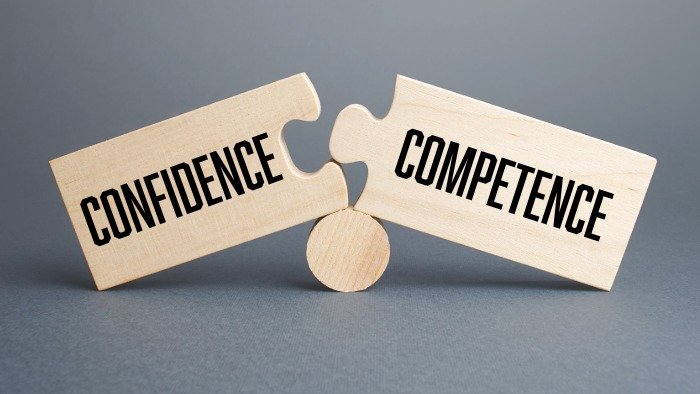
Balance has two sides that people rarely separate:
Confidence - how steady you believe you are.
Competence - how steady you actually are when tested.
Confidence is subjective. It’s shaped by past success, identity, and experience. It’s who we believe we are that gives us confidence.
Competence is measurable. It reflects how effectively your sensory systems, muscles, and reflexes keep you upright when something unexpected happens. We can actually test this in real time.
Earlier in life, perceived and actual balance ability tend to align more closely, but with aging they can drift apart. Researchers studying fall risk have repeatedly found that self-perceived balance ability and objective balance performance are related but not identical predictors of falling. (6, 7, 8)
In other words: confidence and competence overlap, but they are not the same thing.
And when they fall out of alignment, problems begin.
Two Dangerous Mismatches
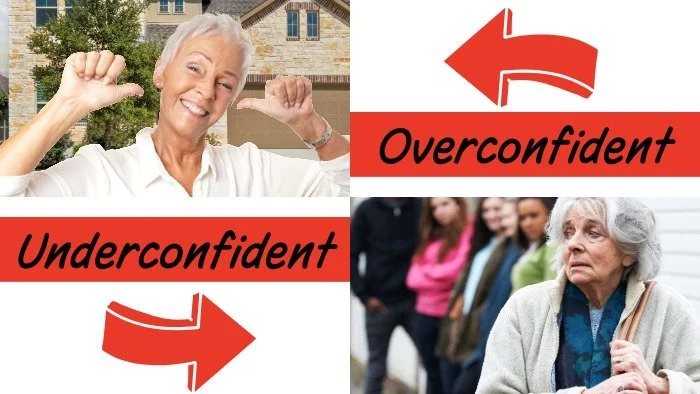
Most people may assume low confidence isn’t the problem, but rather just having overly high confidence is. Surprisingly, research shows both too much and too little confidence can increase fall risk.
A large study by Delbaere and colleagues examined how older adults judged their own fall risk compared with their physical abilities. (9) They identified distinct patterns:
Some people accurately understood their abilities.
Some underestimated themselves and became overly cautious.
Others were overconfident, taking risks beyond their physical capacity.
Both mismatches were associated with higher fall rates, just for different reasons.
Overconfidence: Confidence Without Competence
Overconfidence often develops gradually.
Because decline is slow, and compensated for, the brain updates its self-image more slowly than the body changes. Someone may still feel like the person who hiked mountains or played sports decades earlier. Without recent challenges to provide feedback, the brain assumes ability hasn’t changed.
I often ask my patients (who run anywhere from 55-100) how old they feel in their brain despite their aging body. Most have said somewhere in their 30s, excluding those with any severe physical disability or cognitive deficits who usually respond more in the range of their 50s.
Essentially, it’s not that a person gets more confident, its that their competence declines while confidence remains the same. Some older adults overestimate their physical capacity and accept movement risks inconsistent with their actual performance levels, increasing exposure to falls (10, 11)
Falls then appear to come “out of nowhere,” even though underlying changes have been building for years.
The fall wasn’t sudden, rather awareness of decline was delayed.
Underconfidence: Competence Without Confidence
The opposite mismatch is just as common.
A single fall, even an accidental one involving ice or a slippery floor, can dramatically reduce confidence despite preserved physical ability. Fear of falling leads people to restrict activity, and reduced activity accelerates physical decline. (12, 13) This cycle is well documented: reduced confidence leads to avoidance, avoidance leads to deconditioning, and deconditioning increases future fall risk.
Ironically, trying to stay too safe can make someone less safe over time.
How the Brain Masks Decline
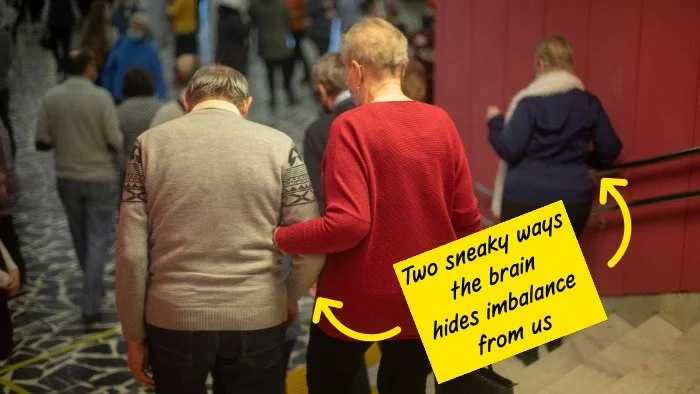
Your brain is an extraordinary problem-solver. When parts of the balance system weaken, it compensates, often without any conscious input from you.
If ankle sensation becomes less precise, vision takes on a larger role. If vestibular signals become unreliable, movement slows to maintain stability, allowing time for sensation and vision to pick up the slack. This process is what we call sensory reweighting, the brains ability to dynamically re-prioritize the three systems of balance at a moments notice. (14, 15)
These adaptations work remarkably well.
People widen their stance slightly. They walk slower. They unconsciously reach for walls or furniture (what I like to call “furniture surfing”), using light touch as an additional source of feedback for spatial awareness. Remarkably, even fingertip contact with a stable surface can significantly improve balance by providing extra sensory information to the nervous system. (16, 17) The most interesting part is that this contact can be extremely light, as low as ~100g of pressure (~.22lbs of pressure) for significant balance improvement.
The catch is that compensation hides declining systems in need.
Research shows that maintaining posture with age increasingly requires cognitive attention and intentional practice, rather than automatic reflexes to overcome some of these deficits. (18, 19, 20) That’s why talking while walking or navigating busy environments becomes more challenging, the brain is using more power while multitasking between thinking and staying upright.
The system still works, but it’s operating closer to its limits.
Why Confidence Changes Slower Than Ability
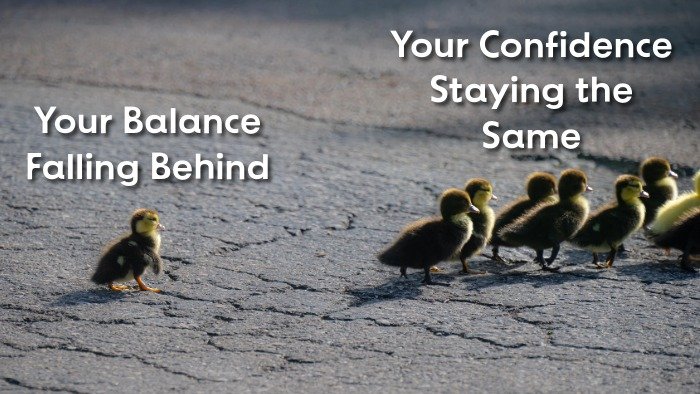
Balance rarely disappears overnight. Instead, small changes accumulate gradually, making them difficult to perceive especially with compensation patterns.
Several psychological factors may help explain why confidence often lags behind competence:
Gradual adaptation: Tiny yearly changes feel normal because they happen slowly. We become accustom to decreased balance without noticing it is actually decreasing (similar to the frog in boiling water analogy).
Reduced physical feedback: Many adults stop exposing themselves to challenging environments that would reveal decline.
Identity persistence: People continue to view themselves through the lens of earlier physical ability because it is a part of their identity as a person.
Cognitive bias. Humans tend to overestimate abilities that aren’t regularly tested, almost like a physical Dunning–Kruger effect.
Research on perception of physical ability confirms that awareness of decline does not always track objective performance changes with aging and can affect fall risk. (21, 22)
Your brain updates its “balance status report” only when reality forces it to.
Recognizing Hidden Balance Decline
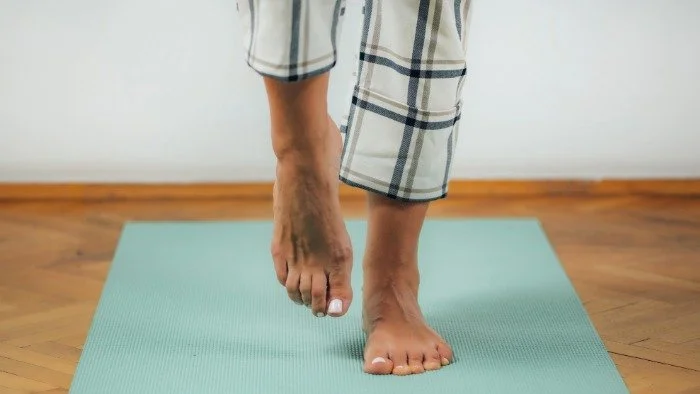
Early balance changes are rarely dramatic. Instead, they appear as small adaptations:
Touching walls while walking
Shorter steps or slower gait
Difficulty multitasking while moving
Feeling the need to consciously focus on balance
Objective medical or at home testing often reveals changes before people notice problems themselves.
For example, inability to maintain a single-leg stance for several seconds is associated with elevated fall risk in older adults, while subtle variability in walking patterns predicts future falls even among otherwise healthy individuals. (23, 24)
You don’t have to wait for a fall to learn something has changed.
Practical Self-Tests
You don’t need fancy lab equipment or even a PT to gauge your balance. A few simple home tests can reveal a lot:
Single-Leg Stance Test:
Try to stand on one leg for at least 10 seconds per leg without touching anything.
Struggling to reach that? That’s an early sign of balance decline.
Stand with one foot directly in front of the other as if on a tightrope.
Can you stay steady for at least 10 seconds on each side without stepping out?
Eyes-Closed Balance Test:
Stand with your feet together, close your eyes, and hold your balance.
If you sway significantly or feel uneasy in under 10 seconds, your visual system may be overcompensating for weaker proprioceptive or vestibular inputs. You may be at a higher risk of falling at night time.
The Good News: Balance Is Trainable at Any Age
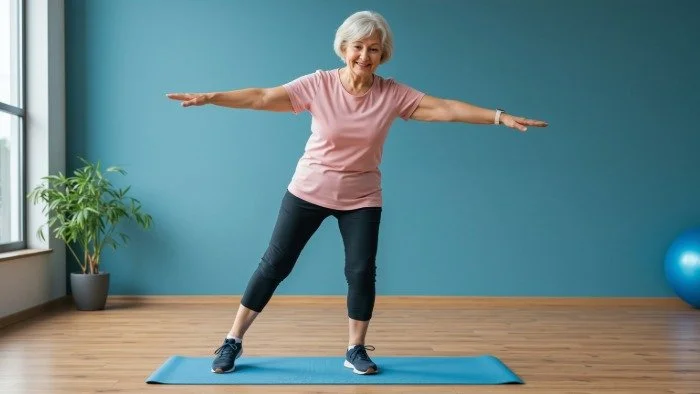
Fortunately, despite any declines you may be experiencing, balance is highly adaptable and trainable throughout life. The nervous system retains the ability to reorganize and improve coordination in a process known as neuroplasticity.
Exercise programs that directly challenge balance and strength consistently reduce fall rates by over 30%. (25) Mind-body practices like Tai Chi can be effective as well, improving sensory integration and postural control while significantly lowering fall risk by 19%.
As physical competence improves, confidence can recalibrate naturally, not because someone convinces themselves they are steady, but because their body repeatedly proves it through action.
Building Real Competence and Confidence for Balance

If you want real balance, the kind that protects you from sudden slips or unexpected stumbles, you need to train it like a skill.
Here’s how to make that happen:
Test Your Balance Regularly: Self-assessment keeps confidence honest. Simple tests like the single-leg stance or heel-to-toe walk give you feedback on how your balance is changing over time. Or you can use testing programs like SoF’s Fall-Proof Scorecard to track your progress and see where you’re fall readiness stands over time.
Include Strength and Mobility Work: Strong legs, hips, and core muscles form the physical base for stability, while joint mobility allows for proper alignment and quick adjustments. Think squats, heel raises, and dynamic stretches, not just static balance poses.
Challenge Your Sensory Systems: Balance isn’t just muscular, it’s sensory. Practice balancing with eyes closed, on uneven or compliant surfaces, or while turning your head. These variations help your brain refine how it integrates vision, vestibular input, and proprioception.
Learn Safe Falling Strategies: Even with perfect balance, falls still happen. A trip, a slippery floor, or a loose rug can take you down in an instant. Knowing how to fall safely can turn a potential injury into a bruise and a story instead of a hospital visit. This is a cornerstone of the Science of Falling philosophy: not just preventing falls, but learning how to handle them.
Real confidence comes from earned competence. It’s the kind of confidence that isn’t shaken by one close call, because you know your body and brain have been trained to handle instability, and you know what to do when something does inevitably go wrong.
Final Thoughts: Bridging the Confident-to-Competent Gap
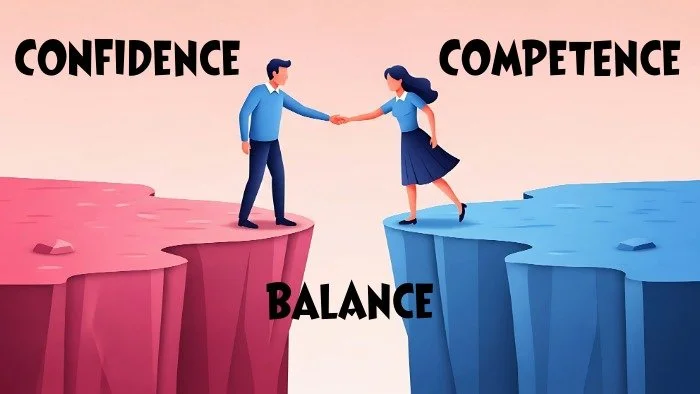
If you’ve learned anything from this article let it be this:
Confidence is a feeling- your perception of steadiness.
Competence is a skill- your true, measurable ability to stay upright and recover from instability.
As we age, those two can drift apart. The danger isn’t in feeling confident, it’s in assuming confidence equals competence. The good news? With the right training, the two can be brought back into alignment.
If you want to age with stability, freedom, and self-trust, be sure to test your balance, challenge your body, and keep learning how to move well. Because balance isn’t lost with age, it’s lost with disuse.
What’s Your Fall Risk Score?
Most people don’t notice their balance declining until something goes wrong.
This 10-minute self-assessment will show you:
• How stable your balance really is
• Where you're most at risk (strength, coordination, or falling ability)
• What to focus on first
No equipment. No guesswork. Just clear answers.
References
Shumway‐Cook A, Woollacott MH. Motor Control: Translating Research into Clinical Practice.; 2006. https://touroscholar.touro.edu/nymc_fac_pubs/4647
Jahn K, Wühr M. Postural control mechanisms in mammals, including humans. In: Elsevier eBooks. ; 2020:344-370. doi:10.1016/b978-0-12-809324-5.24132-1
Hardwick RM, Forrence AD, Costello MG, Zackowski K, Haith AM. Age-related increases in reaction time result from slower preparation, not delayed initiation. Journal of Neurophysiology. 2022;128(3):582-592. doi:10.1152/jn.00072.2022
Horak FB. Postural orientation and equilibrium: what do we need to know about neural control of balance to prevent falls? Age And Ageing. 2006;35(suppl_2):ii7-ii11. doi:10.1093/ageing/afl077
Wang J, Li Y, Yang GY, Jin K. Age-Related Dysfunction in Balance: A Comprehensive review of causes, consequences, and interventions. Aging and Disease. 2024;16(2):714. doi:10.14336/ad.2024.0124-1
Thompson LA, Badache M, Brusamolin JAR, et al. Investigating Relationships between Balance Confidence and Balance Ability in Older Adults. Journal of Aging Research. 2021;2021:1-10. doi:10.1155/2021/3214366
Lajoie Y, Gallagher SP. Predicting falls within the elderly community: comparison of postural sway, reaction time, the Berg balance scale and the Activities-specific Balance Confidence (ABC) scale for comparing fallers and non-fallers. Archives of Gerontology and Geriatrics. 2003;38(1):11-26. doi:10.1016/s0167-4943(03)00082-7
Ting HXT, Ho J, Ong PH, Young WR, Soh SLH. Convergent and predictive validity of the activities-specific balance confidence scales and balance recovery confidence scale, with regard to the falls efficacy scale-international: a cross-sectional study. Frontiers in Aging. 2025;6:1330612. doi:10.3389/fragi.2025.1330612
Delbaere K, Close JCT, Brodaty H, Sachdev P, Lord SR. Determinants of disparities between perceived and physiological risk of falling among elderly people: cohort study. BMJ. 2010;341(aug18 4):c4165. doi:10.1136/bmj.c4165
Fortinsky RH, Panzer V, Wakefield D, Into F. Alignment between balance confidence and fall risk in later life: Has over-confidence been overlooked? Health Risk & Society. 2009;11(4):341-352. doi:10.1080/13698570903015735
Ickert EC, Hughes T, Berg-Carramusa CA, Dudash S, Kerns L. Overestimation of balance ability among older adults at risk for falls. Journal of Aging and Health. 2023;36(5-6):286-298. doi:10.1177/08982643231186630
Liu M, Hou T, Li Y, et al. Fear of falling is as important as multiple previous falls in terms of limiting daily activities: a longitudinal study. BMC Geriatrics. 2021;21(1):350. doi:10.1186/s12877-021-02305-8
Young WR, Williams AM. How fear of falling can increase fall-risk in older adults: Applying psychological theory to practical observations. Gait & Posture. 2014;41(1):7-12. doi:10.1016/j.gaitpost.2014.09.006
Assländer L, Peterka RJ. Sensory reweighting dynamics in human postural control. Journal of Neurophysiology. 2014;111(9):1852-1864. doi:10.1152/jn.00669.2013
Dewan BM, James CR, Kumar NA, Burgess N, Zupancic S, Sawyer SF. Adaptation in motor strategies for postural control associated with sensory reweighting. Human Movement Science. 2023;89:103098. doi:10.1016/j.humov.2023.103098
Dickstein R, Shupert CL, Horak FB. Fingertip touch improves postural stability in patients with peripheral neuropathy. Gait & Posture. 2001;14(3):238-247. doi:10.1016/s0966-6362(01)00161-8
Stabilization of posture by precision contact of the index finger. PubMed. Published August 1, 1994. https://pubmed.ncbi.nlm.nih.gov/7921347/
Doumas M, Rapp MA, Krampe RTh. Working Memory and Postural Control: Adult Age Differences in Potential for Improvement, Task Priority, and Dual Tasking. The Journals of Gerontology Series B. 2009;64B(2):193-201. doi:10.1093/geronb/gbp009
Tsang WWN, Chan VWL, Wong HH, Yip TWC, Lu X. The effect of performing a dual-task on postural control and selective attention of older adults when stepping backward. Journal of Physical Therapy Science. 2016;28(10):2806-2811. doi:10.1589/jpts.28.2806
Rubega M, Formaggio E, Di Marco R, et al. Cortical correlates in upright dynamic and static balance in the elderly. Scientific Reports. 2021;11(1):14132. doi:10.1038/s41598-021-93556-3
Araújo L, Teixeira L, Ribeiro O, Paúl C. Objective vs. Subjective Health in Very Advanced Ages: Looking for Discordance in Centenarians. Frontiers in Medicine. 2018;5:189. doi:10.3389/fmed.2018.00189
Calvey B, Power JM, Maguire R, Welmer AK, Calderón-Larrañaga A. How Do Discrepancies between Subjective and Objective Health Predict the Risk of Injurious Falls? A Study of Community-Dwelling Swedish Older Adults. Journal of the American Medical Directors Association. 2024;25(8):105072. doi:10.1016/j.jamda.2024.105072
Single leg stance or “One-legged stance test.” Shirley Ryan AbilityLab. Published June 27, 2013. https://www.sralab.org/rehabilitation-measures/single-leg-stance-or-one-legged-stance-test
Kim U, Lim J, Park Y, Bae Y. Predicting fall risk through step width variability at increased gait speed in community dwelling older adults. Scientific Reports. 2025;15(1):16915. doi:10.1038/s41598-025-02128-2
Sherrington C, Fairhall N, Wallbank G, et al. Exercise for preventing falls in older people living in the community: an abridged Cochrane systematic review. British Journal of Sports Medicine. 2019;54(15):885-891. doi:10.1136/bjsports-2019-101512