
Where Should You Look When Walking for Better Balance and Safety?

Essential Points:
A few steps ahead is a good visual "home base." I commonly cue about 6 to 8 feet, although research doesn't establish one universal perfect distance.
Looking down isn't bad. You should move your gaze toward obstacles, stairs, uneven ground, and anything else that requires more precise foot placement.
Your surroundings matter. Busy patterns, crowds, and moving visual environments can make balance more difficult for some people. Looking toward stable visual references may help you better orient yourself in space.
Where should I look when I'm walking?
It sounds like a simple question. But it's one I get surprisingly often from my patients.
Should you look straight ahead? At the floor? At your feet? Should you constantly scan for obstacles?
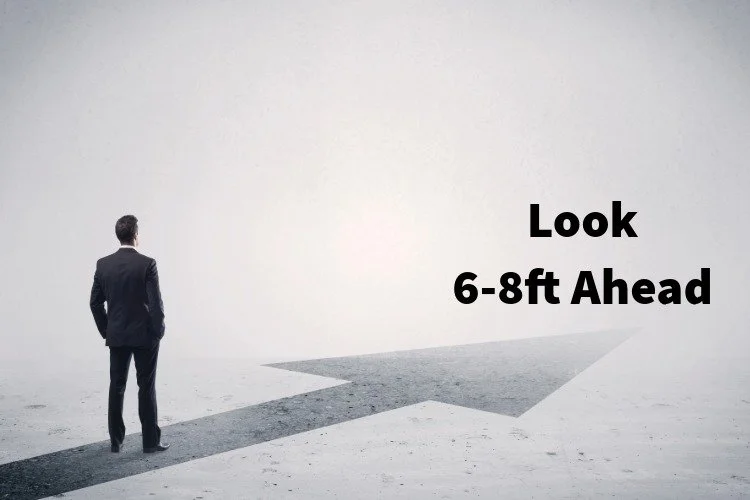
My usual answer is pretty simple, start by looking about 6 to 8 feet in front of you.
I use that distance as a practical "home base." It lets you see what's coming next without staring directly at your feet, while still keeping the ground and much of the surrounding environment within your visual field.
But there's an important second part to that advice.
Your eyes shouldn't stay there.
If you need to step over something, look at it. If you're approaching a curb, look down. If someone walks across your path, look toward them. If you're turning, look where you're going.
Get the job done safely, then return your gaze several feet ahead.
The goal isn't to find one perfect place to stare while walking.
The goal is to use your vision strategically.
Your Eyes Help Plan Your Next Steps
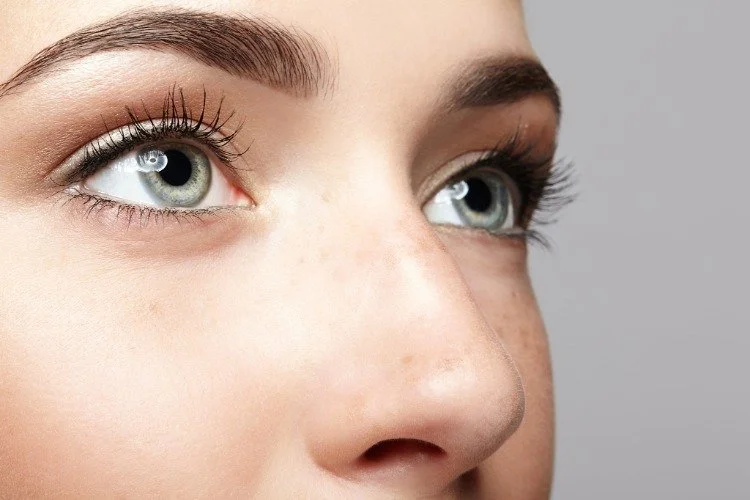
Walking may feel automatic, but your brain is constantly planning ahead.
Vision tells you about the surface you're walking on, upcoming obstacles, changes in elevation, available places to step, the direction you're moving, and what's happening around you.
Luckily, you don't need to consciously think about all of this information. Your nervous system is doing a lot of the work behind the scenes.
Researchers studying gaze during walking have found that people often gather visual information before they actually need it.
In one classic study, people walking toward specific stepping targets tended to fixate on those targets about two steps before reaching them. This gave the nervous system time to modify the upcoming walking pattern.(1)
Another study found that when people walked through complex terrain, limiting their visible path to less than about two step lengths increased obstacle contacts. Once people could see at least two steps ahead, their performance improved.(2)
That helps explain why staring directly at your feet isn't always the best strategy.
If you're only watching where your feet are right now, you're giving yourself less opportunity to prepare for what's coming next.
Your eyes should generally lead your feet.
Why I Tell Patients to Look About 6 to 8 Feet Ahead
I want to be clear about something.
Six to eight feet isn't a magic number established by research.
It's a clinical cue I've found useful with my patients.
For most people, it places their gaze several steps ahead rather than directly at their shoes or all the way at the other end of the hallway.
Interestingly, research seems to support the general idea behind the cue.
One study tested how different downward gaze positions affected standing and walking steadiness. Looking down a few steps ahead, including targets 1 and 3 meters away, produced steadier posture than some other gaze conditions. (3)
Six to eight feet is roughly 1.8 to 2.4 meters.
That doesn't prove my cue is the "correct" distance. Walking speed, height, vision, environment, balance ability, and the task itself can all change where you should look.
But it does fit nicely with a broader pattern in the research.
Looking a few steps ahead seems to provide useful information for both planning your movement and controlling your body in space.
That's why I think of 6 to 8 feet as a starting position, not a rule.
Don't Be Afraid to Look Down

Sometimes patients hear advice like, "Don't look at the ground when you walk."
I don't really like that advice.
There are plenty of times when you absolutely should look down:
If there's a curb in front of you, look at it.
If you're stepping over a cord, look at it.
If you're walking across an uneven trail, inspect the ground.
If you need to place your foot in a very specific spot, look where you're trying to step.
Research with older adults shows why this matters.
Older adults at higher risk of falling have been found to sometimes move their gaze away from a stepping target too early. In one study, researchers instructed participants to keep looking at the target until their foot contacted it. That change improved stepping accuracy and reduced errors. (4)
So, the problem isn't looking down.
The problem is getting visually stuck there when you no longer need that information.
There is an important difference between staring at your feet for an entire hallway and looking down briefly because you're negotiating an obstacle.
The second is exactly what your visual system is supposed to do.
Once the obstacle is handled, you can lift your gaze and start gathering information farther ahead again.
Vision Does More Than Help You Avoid Obstacles
There's another reason I encourage people to look beyond their feet.
Your eyes aren't only searching for things you might trip over. Vision also helps your brain understand where your body is in space.
Your balance system combines information from your eyes, inner ears, muscles, joints, and other sensory systems to estimate how you're positioned and moving.
Stable parts of the environment can provide useful visual information for this process.
Think about the vertical edge of a doorway, the corner of a room, a wall, a railing post.
These features give your brain relatively stable information about the environment around you.
Laboratory research supports this idea. In one study involving healthy women between 55 and 70 years old, visual surroundings containing vertical cues produced less postural sway than surroundings dominated by horizontal cues. (5)
Other research has found that stationary visual backgrounds can help stabilize posture, while moving visual backgrounds can increase sway. (6)
This doesn't mean your nervous system literally needs to find a vertical line every time you walk.
But it does show that the visual structure of the environment can influence balance. And I see this play out in the real world all the time.
The Carpet That Makes People Dizzy
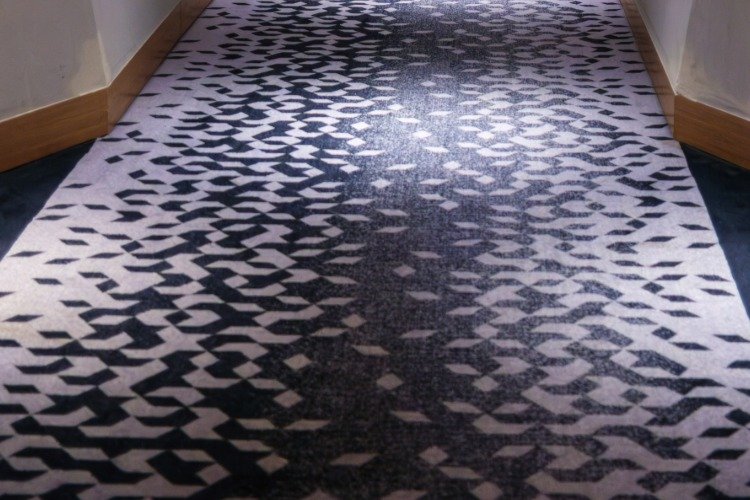
One of the assisted-living buildings where I work has an intricately patterned carpet.
It's visually busy. I've had multiple residents tell me independently that looking at it makes them feel dizzy or disoriented.
And when you look closely at the carpet, there's very little obvious visual structure to anchor yourself to. It's mostly an expanse of repeating patterns underneath you. And to be honest, its main job is to hide stains, not keep people balanced.
When someone is uncomfortable looking at it, I'll often tell them to lift their gaze farther ahead.
Instead of staring directly into the pattern, I might have them notice the edge of a wall, the corner of the hallway, a doorway, or another stable feature farther away.
I'm essentially trying to give their visual system cleaner information about the space around them.
And there is some interesting science behind what they're experiencing.
Complex visual scenes can provoke dizziness or unsteadiness in people who are particularly sensitive to visual motion or who rely heavily on visual information for orientation.
The international diagnostic criteria for persistent postural-perceptual dizziness, or PPPD, specifically recognize visually complex environments as potential symptom triggers. Examples include crowds, busy carpeting, large store displays, and passing traffic. (7)
That doesn't mean someone who dislikes a patterned carpet has PPPD.
It also doesn't mean patterned carpets are automatically dangerous.
People respond to visual environments differently. But the experience itself is very real.
Research has also shown that moving visual scenes can alter postural sway, and older adults may sometimes be more affected by these visual environments than younger adults. (8)
So when someone tells me, "that floor makes me dizzy." I believe them.
The visual environment can absolutely influence how steady you feel.
Crowds Can Create the Same Problem
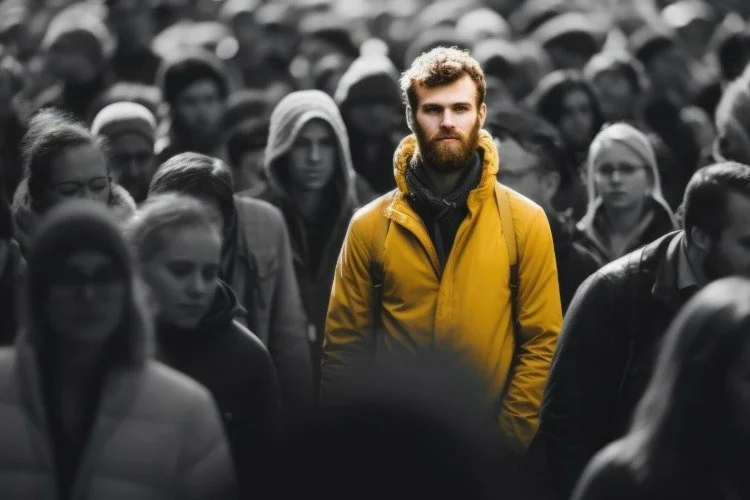
A complicated carpet is mostly stationary. Now imagine the same visual challenge with everything moving.
You're walking through a crowded restaurant. People are crossing in front of you. Someone passes on your left. Another person walks toward you. Chairs are moving. Your walking path keeps changing.
There's suddenly a lot of visual information competing for your attention.
For most people, the brain sorts through this remarkably well.
But if you're more visually dependent, have a vestibular problem, or already feel insecure while walking, a busy environment can become much harder to process. (7)
This is another reason why "just look straight ahead" isn't very useful advice.
You need to scan the environment, identify what's important, respond to it, and then return your gaze to a useful position.
Walking safely is an active visual task.
Think of 6 to 8 Feet as Your Visual Home Base
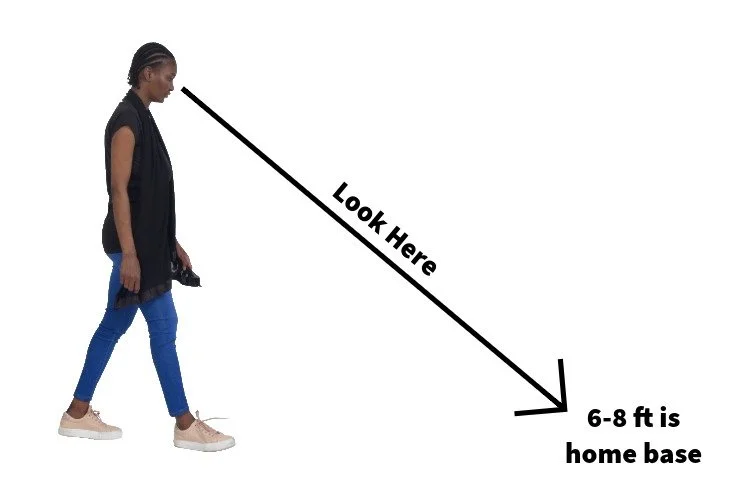
This is how I usually teach the idea.
Start by looking roughly 6 to 8 feet ahead. From there, let your eyes move wherever the task requires.
Obstacle? Look at it.
Curb? Check your foot placement.
Turn? Look where you're going.
Person walking toward you? Track what they're doing.
Confusing floor pattern? Try lifting your gaze toward a more stable part of the environment.
Once you've handled the immediate problem, return to your home base and start gathering information about what's coming next.
Your gaze should be active and adaptable, just like your balance system.
A Simple Walking Experiment

The next time you're walking through a safe, familiar hallway, pay attention to where you're looking.
Don't change anything at first. Just notice:
Are you staring directly at your feet?
Looking 30 feet away?
Scanning constantly?
Then try shifting your gaze a few steps ahead. Notice how much information you can still see.
You may be surprised by how much of the floor close to you remains visible without directly staring at it.
Then walk toward a doorway or another safe visual target. Let your eyes move toward the information you need, then naturally move forward again.
The goal isn't to force yourself into one rigid gaze position.
It's to become better at using vision to guide your movement.
Final Thoughts: Looking Ahead For Safety

So where should you look when you're walking? There's probably no single perfect answer.
But for many of my patients, I start with a simple cue:
Look about 6 to 8 feet ahead.
That gives you a useful view of where you're going while still allowing you to gather information from the environment around you.
Then adapt:
Look down when you need to.
Look toward obstacles.
Look through turns.
Look for stable visual references when the environment feels confusing.
And once you've handled the immediate challenge, bring your gaze forward again.
Your eyes shouldn't be locked in one place. They should be helping you solve the walking problem that's in front of you.
What’s Your Fall Risk Score?
Most people don’t notice their balance declining until something goes wrong.
This 10-minute self-assessment will show you:
• How stable your balance really is
• Where you're most at risk (strength, coordination, or falling ability)
• What to focus on first
No equipment. No guesswork. Just clear answers.
References
Patla AE, Vickers JN. How far ahead do we look when required to step on specific locations in the travel path during locomotion? Exp Brain Res. 2003;148(1):133-138. doi:10.1007/s00221-002-1246-y
Matthis JS, Fajen BR. Visual control of foot placement when walking over complex terrain. J Exp Psychol Hum Percept Perform. 2014;40(1):106-115. doi:10.1037/a0033101
Koren Y, Mairon R, Sofer I, Parmet Y, Ben-Shahar O, Bar-Haim S. Gazing down increases standing and walking postural steadiness. R Soc Open Sci. 2021;8(3):201556. doi:10.1098/rsos.201556
Young WR, Hollands MA. Can telling older adults where to look reduce falls? Evidence for a causal link between inappropriate visual sampling and suboptimal stepping performance. Exp Brain Res. 2010;204(1):103-113. doi:10.1007/s00221-010-2300-9
Simoneau GG, Leibowitz HW, Ulbrecht JS, Tyrrell RA, Cavanagh PR. The effects of visual factors and head orientation on postural steadiness in women 55 to 70 years of age. J Gerontol. 1992;47(5):M151-M158. doi:10.1093/geronj/47.5.M151
Thomas NM, Bampouras TM, Donovan T, Dewhurst S. Eye movements affect postural control in young and older females. Front Aging Neurosci. 2016;8:216. doi:10.3389/fnagi.2016.00216
Staab JP, Eckhardt-Henn A, Horii A, et al. Diagnostic criteria for persistent postural-perceptual dizziness (PPPD): consensus document of the committee for the Classification of Vestibular Disorders of the Bárány Society. J Vestib Res. 2017;27(4):191-208. doi:10.3233/VES-170622
Borger LL, Whitney SL, Redfern MS, Furman JM. The influence of dynamic visual environments on postural sway in the elderly. J Vestib Res. 1999;9(3):197-205. doi:10.3233/VES-1999-9307