
How Your Arms Help You Balance and Recover From a Fall

Updated: 9/5/2026
Essential Points:
Your arms are active balance tools. They help control rotation, counterbalance the body, and reach for support.
When balance is lost, the arms coordinate with the legs and trunk to help you recover. If a fall continues, their role shifts toward protecting the body and managing impact.
Shoulder pain, stiffness, or weakness can remove some of these options. Improving comfortable arm movement may help restore an important part of your overall fall preparedness.
When you suddenly lose your balance, watch what your arms do.
They might shoot out to the sides, swing forward, reach for a railing, or prepare for contact with the ground. The movements can look chaotic and frantic sometimes, but they aren't random. Your arms are joining the rest of your body in an attempt to solve the problem of falling and keep you safe.
Balance is often treated like a lower-body skill. We talk about the feet, ankles, hips, and legs. We also talk about the three sensory systems that provide the brain with information about balance including vision, the vestibular system, and the somatosensory system.
But knowing that you're losing your balance is only part of the process. Your body has to do something with that information too.
That's where your arms come in.
Your arms aren't a fourth balance system. They're movable tools that can help you remain upright, recover when balance is lost, protect yourself during a fall, and even assist you once you're on the ground.
In other words, your arms can play a role across nearly the entire Falling Continuum.
Your Arms Are Movable Balance Tools
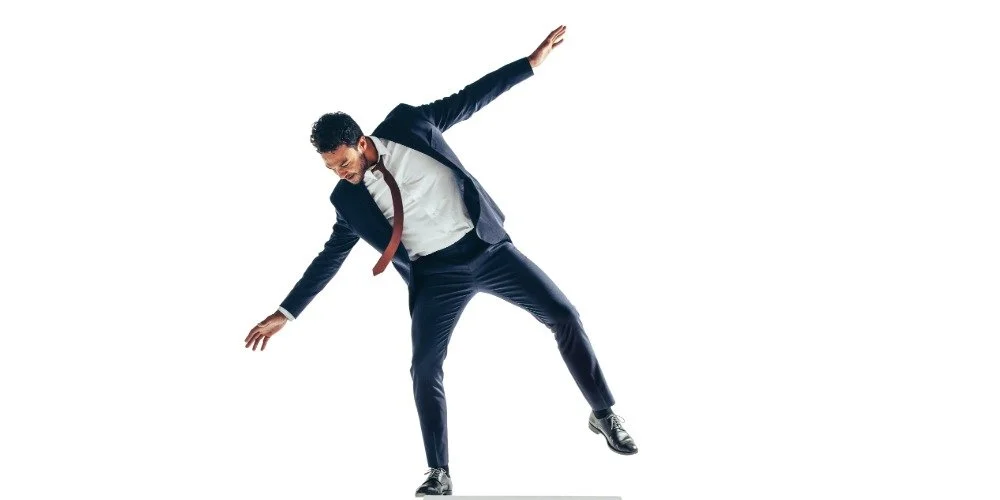
Your arms account for a meaningful portion of your body's mass. Consequently, changing their position also changes how the rest of your body moves.
Extending your arms farther from your body increases resistance to rapid rotation. Swinging an arm can create a force that counters unwanted movement. Your arms can also shift your center of mass (CoM) slightly toward or away from the direction you're beginning to fall.
Researchers sometimes describe this as an upper-body balance strategy. It works alongside the relatively more familiar ankle and hip strategies used to maintain balance.
A 2025 systematic review and meta-analysis combined 25 studies involving 725 people. Overall, participants performed moderately better on static, dynamic, proactive, and reactive balance tasks when they could use their arms freely. The benefits were generally bigger as the balance tasks became more difficult. (1)
This doesn't mean wildly swinging your arms will fix every balance problem. It means your arms give your body more ways to respond when a balance loss does happen.
What Philippe Petit Can Teach Us About the Arms
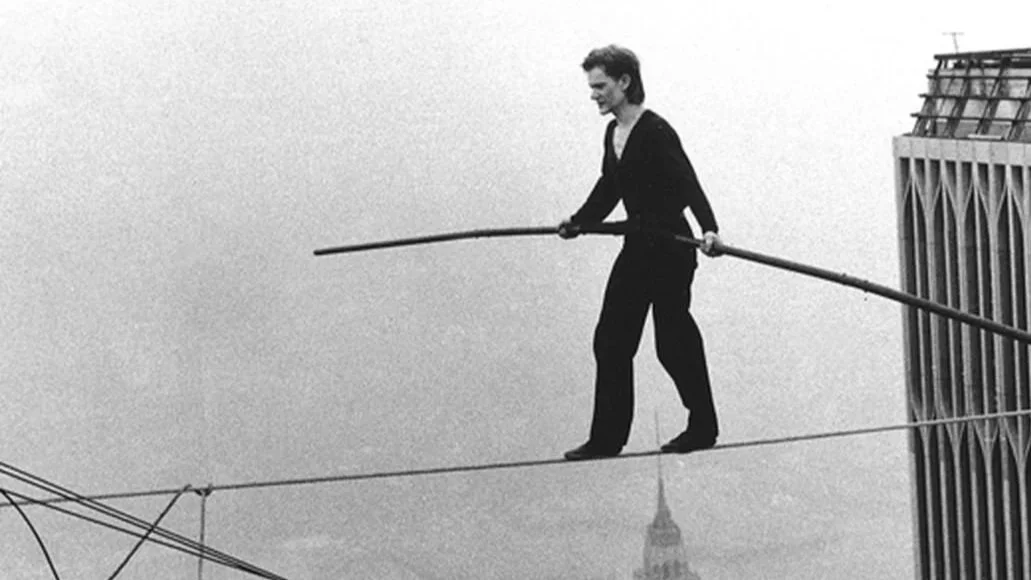
Tightrope walking offers one of the clearest examples of this idea.
In 1974, Philippe Petit famously walked on a wire between the Twin Towers of the World Trade Center. He carried a 26-foot balance pole during the walk. The pole wasn't a decoration. By spreading mass far away from the center of his body, it increased resistance to unwanted rotation and gave him more time to make corrections. It quite literally was an extension of his arms.
I explored Petit's incredible performance more fully in The Art and Science of Tightrope Walking, but we can experience a much safer version of this principle close to the ground.
I notice it whenever I practice beam balancing. The more imbalanced I feel on the beam, the more active my arms become. They don't simply remain stretched straight out like I'm posing for a picture. One might move forward while the other moves backward. They lift, drop, rotate, and make constant adjustments based on what the rest of my body is doing. Sometimes these movements have to be extremely subtle for small adjustments, or extremely large and fast if I am in danger of falling.
If I place my hands on my hips, the beam immediately becomes more difficult. I've removed one of the strategies my body normally uses to stay balanced.
Research using narrow beams supports my experience. As the beam became narrower and the task became harder, the contribution of upper-body movement increased. With spontaneous or outstretched arm movements, the upper body contributed to balance stabilization to a similar extent as the lower body. (2)
Before a Fall, the Arms Help Control Movement

Your arms contribute to balance long before a stumble occurs.
During normal walking, your arms usually swing opposite your legs. This helps manage the rotational forces produced by your legs and pelvis, limits excessive torso movement, and makes walking feel smoother. Your arms don't primarily swing to propel you forward, although that does happen to a degree. Their larger role is helping the rest of your body manage rotation efficiently. (3)
The same principle appears during many everyday activities:
Walking over uneven ground
Turning quickly
Reaching outside your base of support
Stepping over an obstacle
Moving through a crowded environment
Standing on a narrow or unstable surface
This becomes especially interesting when your arms aren't available.
Think about walking while carrying grocery bags, holding a laundry basket, looking at a phone, or carrying a child. Your balance systems haven't stopped working, but some of your normal movement options have been removed because your arms are otherwise occupied.
Even clinical balance and mobility tests can change when arm movement is restricted. One small study found that participants performed better on three of four tests when they could use their arms freely. (4)
You might feel steady when your arms are available but have more difficulty when you're carrying something. That doesn't mean your balance suddenly disappeared. It means the task took away one of your strategies and became relatively harder in the moment.
When Balance Is Lost, the Arms Join the Recovery
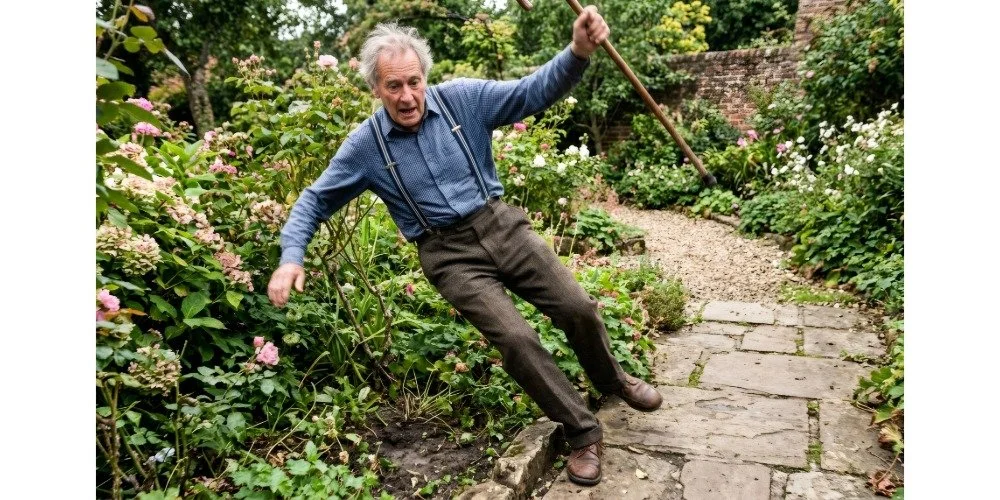
When you slip, trip, or miss a step, balance recovery becomes a whole-body reaction.
Your legs can take a rapid step, your trunk might bend or rotate, and your arms may swing, reach, or change direction. These actions occur together, often before you have time to consciously plan what to do.
During a backward loss of balance, your arms might swing forward to counteract your body's backward movement. During a sideways loss, they may spread or move in opposite directions to help manage rotation. During a trip, arm movement can help control your forward momentum while your legs attempt a recovery step.
These are counterbalancing arm reactions. Their exact direction and speed depend on the type and severity of your balance loss.
In a small study of simulated slips, faster forward arm elevation during the strongest perturbation was associated with better stability during the first recovery step. The older participants also had more difficulty increasing the speed of their arm response as the slip intensity increased. (5)
This is an interesting finding, but it doesn't prove that repeatedly practicing fast arm raises will prevent falls. The important part is how your arms coordinate with your step, trunk, and direction of the balance loss.
Sometimes the Best Arm Reaction Is to Grab Something
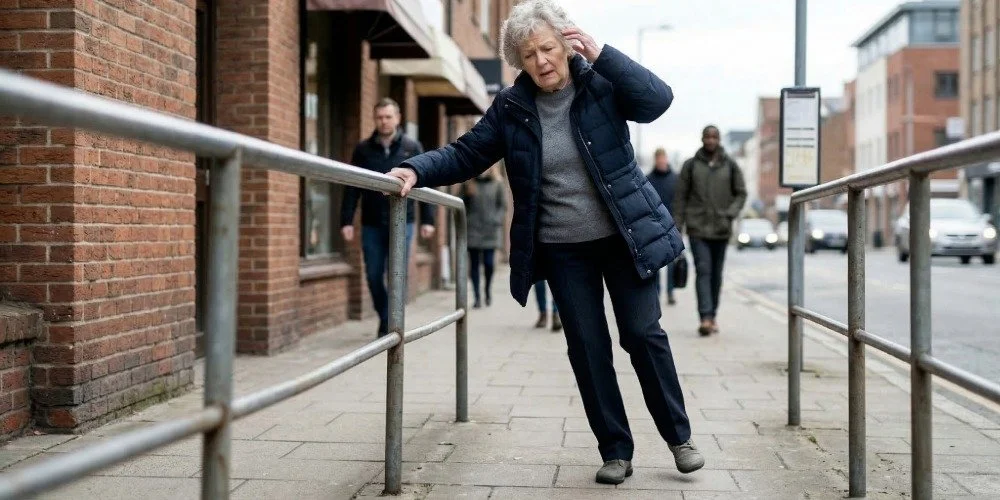
Your arms don't always need to counterbalance your body directly to save a loss of balance. Sometimes their best strategy is to connect you to the environment physically.
Reaching for a railing, wall, countertop, or sturdy piece of furniture can create an entirely new source of support. A firm grasp can help stop your body's motion and expand the area available for maintaining balance.
Even very light fingertip contact can reduce postural sway when the surface is stable. The force might be too small to hold you up, but the contact provides an extra spatial reference that helps your brain understand how your body is moving and can instantly improve balance. (6)
This is different from physical support. Light touch provides information. Grabbing a railing can provide both information and physical assistance.
Researchers often call these reach-to-grasp reactions. They're different from counterbalancing movements, even though both may happen during the same loss of balance.
When a Shoulder Problem Becomes a Balance Problem

I regularly work with patients who have significant shoulder arthritis. They usually come to therapy because reaching into a cabinet hurts, getting dressed has become difficult, or they can no longer lift an arm comfortably above shoulder height.
But the problem doesn't always remain confined to the shoulder.
I often notice these patients guarding the painful arm close to the body during balance activities. They often hesitate to lift it quickly, reach out to the side, or grab a support outside their immediate reach. Even when their legs react appropriately, their upper body has fewer ways to help.
This changes what we focus on in therapy sometimes, especially if there is a balance concern as well.
Improving shoulder comfort, mobility, and strength is still important for reaching shelves, dressing, and other daily activities. But I also want the arms to become available as safety tools again. That means becoming more comfortable lifting an arm to counterbalance, reaching toward a railing, pushing away from a surface, or helping control the body during an unexpected movement.
Treating shoulder arthritis by itself hasn't been proven to prevent falls. However, restoring comfortable movement can give you back options that pain and stiffness had taken away.
The same idea can apply to weakness, previous fractures, neurological conditions, or any problem that limits how quickly and confidently the arms can move. Restoring movement as close to normal as possible is a worthwhile goal.
Arm Reactions Can Change With Age
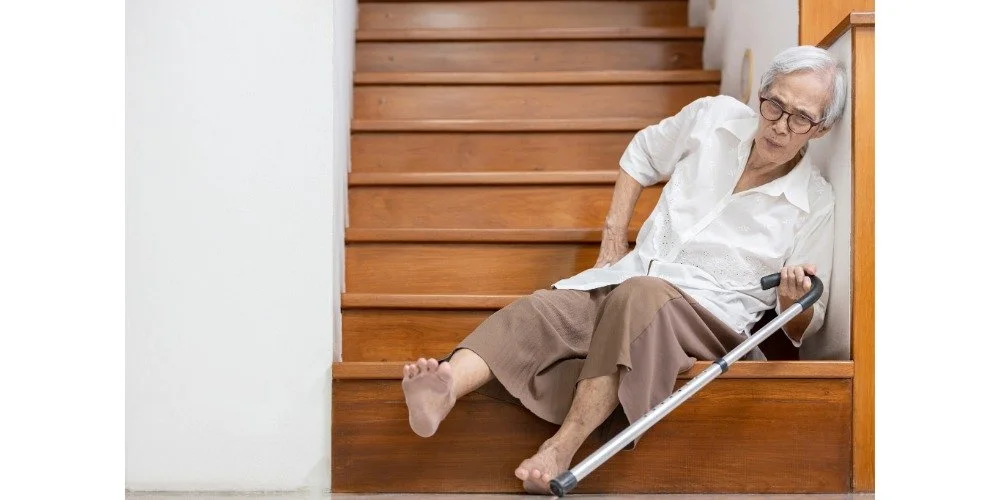
Arm reactions are just as important when you’re older as when you were younger. If anything, difficult balance tasks may increase your need for upper-body strategies, especially as you age. One study found that restricting arm movement caused greater instability in older adults, particularly as the standing tasks became more difficult. (7)
At the same time, the ability to use those strategies can change.
A systematic review of 15 studies found several differences between younger and older adults during sudden balance disturbances. These included later muscle activation, slower or altered arm movements, greater grasping errors, and higher impact forces. (8)
Researchers don't yet know whether every difference represents a true impairment. Some might just be compensations for other age-related changes. Still, the findings reinforce an important idea that balance recovery doesn't belong only to your legs, particularly when you’re aging.
When the Arms Shift From Recovery to Protection
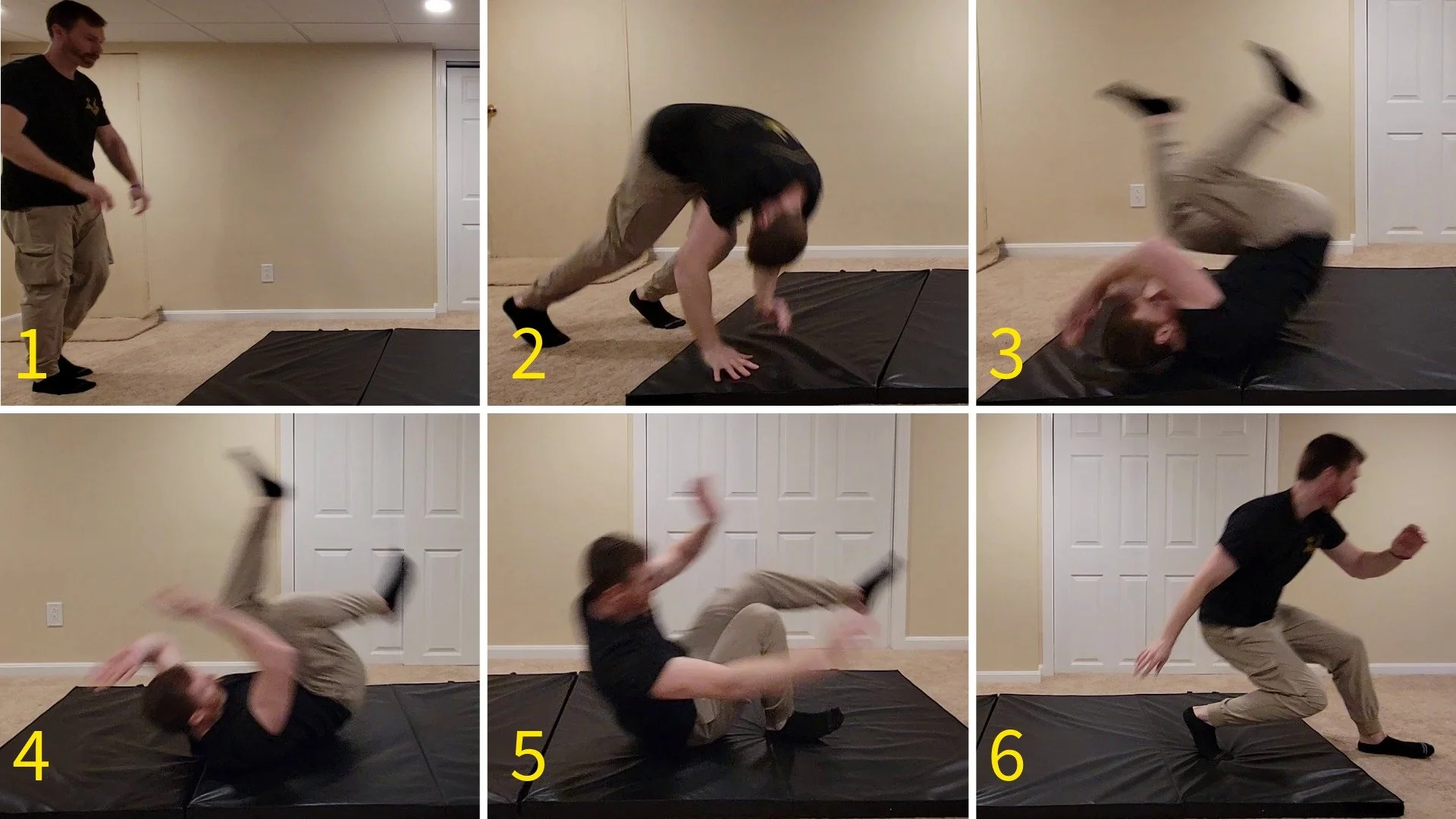
The honest truth is, not every loss of balance can be stopped.
At some point, your nervous system recognizes that staying upright is no longer possible. At that point the job of your arms begins to change. Instead of trying only to restore balance, they prepare to protect your head and manage contact with the ground.
During a forward fall, your hands and arms instinctively move toward the surface before your head or trunk arrives. This reaction can help protect more vulnerable areas of your body. However, the forces still have to go somewhere. If your elbows remain rigid and your entire fall is stopped abruptly through your hands, large forces can travel through your wrists, elbows, and shoulders.
This is one reason a fall on an outstretched hand (FOOSH) can protect the head but injure the arm.
Research comparing younger and older adults during simulated forward falls found that both groups could orient their arms into a protective position. The older adults, however, had more difficulty preventing greater body impact after contact. (9)
Falling techniques depend on the direction of your fall, the speed of your movement, the surface, and the options available. That changes the equation sometimes. Whenever possible, your goal is to make contact gradually, allow your joints to bend, spread force across your body, and lengthen the time available to slow down. I explore these tradeoffs more fully in my article on ROLL SAFE.
Your Arms Still Matter After You Reach the Ground
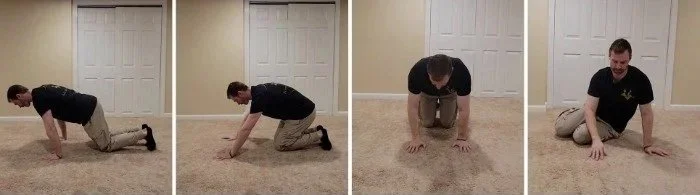
The role of your arms doesn't necessarily end after impact.
Once you're on the floor, your arms can help you roll, reposition, crawl toward a stable support, push up from the ground, or use a chair during a floor-to-stand transfer. A painful or weak shoulder can make this part of the Falling Continuum harder too.
This is another reason I don't view shoulder function as separate from fall preparedness. Your arms contribute before a fall, during the fall, and throughout the recovery that follows.
Should You Allow or Restrict the Arms During Balance Training?

This research creates an interesting training question.
Should you let your arms move freely, or should you hold them still to make an exercise more challenging?
The answer depends on the purpose of your exercise. Personally, I let people use their arms as much as they need to better mimic the real-world situations they might encounter, but let’s investigate a bit further.
Allow the arms when practicing natural balance
If the goal is to see how you balance in real life, allowing your arms to move naturally usually makes sense. This lets you use the same counterbalancing and reaching strategies that are often available outside the clinic or gym.
Free arm movement can also give you a safer starting point if your balance is limited. As your control improves, the task can gradually become more difficult with less arm use.
Restrict the arms when you intentionally want a harder task
Placing your hands on your hips or across your chest removes an available strategy. This can help isolate the work being done by your ankles, knees, hips, and trunk. It can also make testing more consistent between attempts, although with the caveat of being less realistic.
But arm restriction should be used deliberately and with a specific purpose in mind.
Keeping your hands still during an exercise doesn't mean that keeping them still is the safest strategy during a real loss of balance. It's simply one way to change the challenge.
Train the reaction, not only the shoulder
Shoulder mobility and strength help make arm movement possible, but balance recovery requires coordination. Your arm must move in the right direction, at the right speed, while your feet and trunk respond to the same event.
This is one reason reactive and perturbation-based training is promising. In one randomized trial, older adults who completed six weeks of perturbation-based balance training improved parts of their compensatory stepping and grasping responses compared with a flexibility and relaxation group. The study was small, and it didn't determine whether these improvements reduced real-world falls, but it showed that coordinated reactions could improve with practice. (10)
The long-term goal isn't simply to build stronger shoulders. It's to integrate your arms back into your body's complete balance response.
Try This Simple Comparison
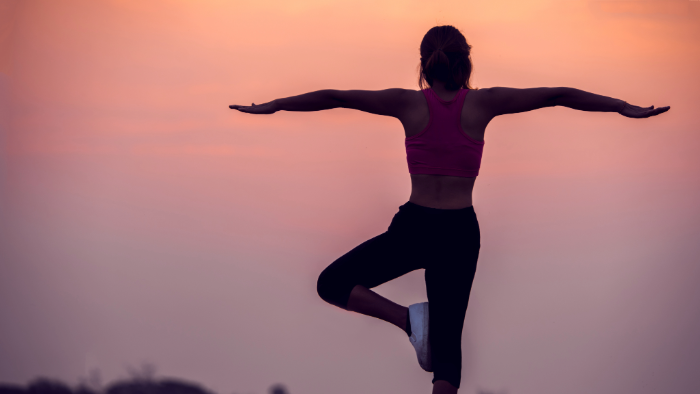
You can feel the contribution of your arms without stepping onto a tightrope.
Stand beside a sturdy countertop and choose a standing position that's appropriately challenging for you. This could be standing with your feet close together, in a staggered stance, or on one leg.
First, allow your arms to move naturally. Notice what they do as your body makes small corrections.
Next, place your hands on your hips or gently cross them over your chest. Does the position feel different? Do your feet, hips, or trunk work harder? Does your body sway more?
Finally, free the arms again and see whether the task becomes easier.
The goal isn't to force yourself to lose balance. It's to notice a strategy that normally operates in the background. Use a stable support, and don't attempt a challenging position alone if you have frequent falls, dizziness, or significant balance difficulty.
Final Thoughts: Give Your Balance a Hand

Your arms aren't passive passengers during balance.
Before a fall, they help manage rotation and control movement. When you lose your balance, they counterbalance your body, coordinate with your steps, and reach for support. If your fall continues, they help protect your body and manage impact. Once you're on the ground, they can help you move and get back up.
Your arms aren't a secret cure for falling. They're one underappreciated part of a much larger system. A part I often address with my patients on many levels.
The next time you stumble and your arms suddenly fly into action, remember that they aren't panicking. They're trying to solve the fall and keep you safe.
What’s Your Fall Risk Score?
Most people don’t notice their balance declining until something goes wrong.
This 10-minute self-assessment will show you:
• How stable your balance really is
• Where you're most at risk (strength, coordination, or falling ability)
• What to focus on first
No equipment. No guesswork. Just clear answers.
References
Borgmann K, Muehlbauer T, Hill MW. Help! You need your hands: contribution of arm movements on balance performance in healthy individuals: a systematic review with meta-analysis. PLoS One. 2025;20(5). doi:10.1371/journal.pone.0323309
Boström KJ, Dirksen T, Zentgraf K, Wagner H. The contribution of upper body movements to dynamic balance regulation during challenged locomotion. Front Hum Neurosci. 2018;12:8. doi:10.3389/fnhum.2018.00008
Pontzer H, Holloway JH IV, Raichlen DA, Lieberman DE. Control and function of arm swing in human walking and running. J Exp Biol. 2009;212(Pt 4):523-534. doi:10.1242/jeb.024927
Milosevic M, McConville KMV, Masani K. Arm movement improves performance in clinical balance and mobility tests. Gait Posture. 2011;33(3):507-509. doi:10.1016/j.gaitpost.2010.12.005
Jeon W, Wang S, Bhatt T, Westlake KP. Perturbation-induced protective arm responses: effect of age, perturbation-intensity, and relationship with stepping stability: a pilot study. Brain Sci. 2022;12(7):953. doi:10.3390/brainsci12070953
Rabin E, DiZio P, Ventura J, Lackner JR. Influences of arm proprioception and degrees of freedom on postural control with light touch feedback. J Neurophysiol. 2008;99(2):595-604. doi:10.1152/jn.00504.2007
Johnson E, Ellmers TJ, Muehlbauer T, Lord SR, Hill MW. Exploring how arm movement moderates the effect of task difficulty on balance performance in young and older adults. Hum Mov Sci. 2023;89:103093. doi:10.1016/j.humov.2023.103093
Alissa N, Akinlosotu RY, Shipper AG, Wheeler LA, Westlake KP. A systematic review of upper extremity responses during reactive balance perturbations in aging. Gait Posture. 2020;82:138-146. doi:10.1016/j.gaitpost.2020.08.134
Borrelli J, Creath R, Westlake K, Rogers MW. Age-related changes in protective arm reaction kinematics, kinetics, and neuromuscular activation during evoked forward falls. Hum Mov Sci. 2022;81:102914. doi:10.1016/j.humov.2021.102914
Mansfield A, Peters AL, Liu BA, Maki BE. Effect of a perturbation-based balance training program on compensatory stepping and grasping reactions in older adults: a randomized controlled trial. Phys Ther. 2010;90(4):476-491. doi:10.2522/ptj.20090070