

Essential Points:
Modern skydiving is safer than ever, but the most dangerous part of a jump still happens during landing, exactly the problem the parachute landing fall (PLF) was designed to solve.
Although created for military parachutists in the 1940s, the PLF reflects universal principles of safe falling that also appear in martial arts, gymnastics, and parkour.
The story of the PLF reveals a broader lesson: Better technology can reduce risk, but it can also cause important safety skills to fade from practice, even when the laws of physics haven't changed.
Prefer to listen? Here’s a quick audio breakdown with a few extra insights:
Skydiving is often seen as one of the most extreme sports in the world.
A pursuit thought to be reserved for reckless adrenaline junkies. But, despite this cultural viewpoint, it is a highly controlled activity with extremely high safety standards.
Modern parachutes are over engineered for both safety and performance. (1)Jumpers (the common term for a skydiver in the sport) train consistently to be ready for anything that comes their way. Equipment is built with redundancy and reliability in mind.
In most cases, this combination of training and technology allows an experienced jumper to guide themselves back to the ground with a high level of precision.
And yet, despite all of that, the most dangerous part of a jump still happens in the final seconds during the landing. (1, 2)
For decades, skydivers have taught a specific technique for this moment, the parachute landing fall (PLF). It wasn’t optional at one point in time. It was a necessary skill used to reduce injury when landings didn’t go as planned, or with older-style round parachutes, even when they did.
It’s worth saying that I’m not a skydiver.
Gravity and I have a solid understanding, and I don’t feel like testing it further. The closest I’ve come is indoor skydiving for my 16th birthday. It was fun, and maybe I’ll do it again someday, but I think my skydiving career ends there before it ever really takes off.
So, most of what follows comes from investigation and research rather than personal experience.
In fact, the PLF wasn’t something I was familiar with until recently.
I was contacted by a recreational skydiver who was working to bring more attention back to it. His concern was simple. While the PLF remains part of skydiving training, he felt it sometimes receives less practical emphasis than it once did and is increasingly viewed as a backup skill.
Whether that perception reflects the broader skydiving community is difficult to say. Again, I'm simply an outside observer.
But it raised an interesting question, what happens to the safety skills that were built for an earlier era?
More specifically, if the PLF was designed to solve a real problem, did that problem actually disappear?Or did the risks simply become less noticeable as technology improved?
This pattern of risk-forgetfulness isn’t something unique to skydiving.
As technology improves and outcomes become more predictable, there can be a tendency to practice backup safety skills less often. Over time, those skills may become practiced less frequently and can gradually fade from attention. That’s even true when a skill is still undeniably valuable.
It’s the same logic as assuming seat belts matter less because cars have better air bag and crumple systems. The likelihood of a life-changing crash may decrease, but the physics of a crash don’t change. It doesn’t matter how many airbags you have, you still need the seat belt.
The same is true for landing under a parachute.
PLFs may seem less immediately relevant with modern equipment. But when something goes wrong, having a reliable way to handle impact can make a significant difference.
And beyond skydiving, this idea is even more important.
Because at its most fundamental level, the PLF is an example of how the human body can safely fall at high speeds. The same principles show up in everyday accidents, traditional sports, martial arts, and non-traditional movement disciplines like my personal sport of parkour.
Which means that while this article uses the PLF as the main character, it’s really about something much more general. It’s about what happens when control fails and your body has to meet the ground in a survivable way.
To understand why the PLF still matters, and how its role has evolved over time, we first need to understand what a typical parachute landing actually looks like.
What a Typical Parachute Landing Looks Like
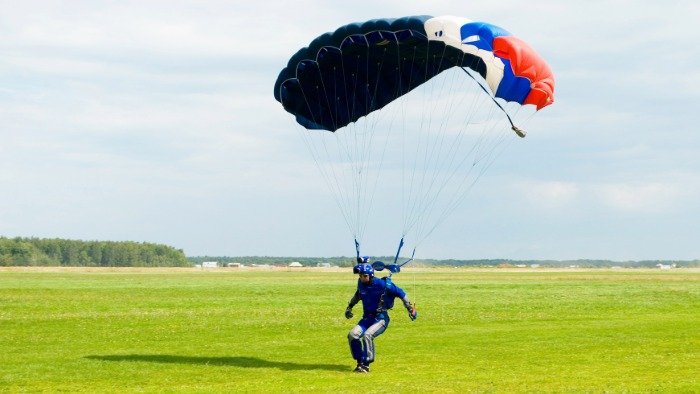
By the time a jumper is preparing to land, the rush of freefall is long over. The parachute has been deployed, the canopy (the fabric portion of the parachute) is stable, and the descent feels controlled and calm.
But “controlled” doesn’t always mean landing is “impact-free.”
While hard to find exact numbers due to the many variables involved in a jump, a typical skydiving descent with a parachute open results in roughly 10–17 mph downward speed and a horizontal speed of 20–30 mph. (3, 4) Without intervention, a jumper landing at these speeds would carry high levels of downward and horizontal momentum, similar to running downhill with little control.
To manage this high level of speed, skydivers use a maneuver called the flare prior to landing. (5)
By pulling down on the control toggles (the handles used to steer the parachute), the canopy changes shape, increasing lift and temporarily reducing descent speed. (5) When timed correctly, the flare burns off a lot of that speed and results in a slower, more gradual touchdown. Ideally this maneuver allows the jumper to step onto the ground or perform a short run landing instead.
In a perfect scenario, this type of landing looks effortless. But perfection depends on timing, conditions, and environment.
And unfortunately, those don’t always align in a skydiver’s favor.
Small errors can change everything:
A flare that’s too early or too late
Unexpected wind shifts or turbulence
Uneven or sloped terrain
Obstacles or off-target landings
When these variables come into play, a soft landing can quickly become a hard one.
From a physics standpoint, the body still has to absorb the remaining falling energy, regardless of how controlled the descent felt. And if that force is concentrated into a single moment or a single joint, the risk of injury increases significantly.
This isn’t unique to skydiving.
You can think of it like stepping off a plyometric box at the gym. Even from relatively low heights (2-4 ft), landing stiff-legged can send a large shock through the ankles, knees, and spine. Not a fun experiment to try by any means. But, land with soft bent knees that can absorb the shock, and the impact is barely felt at all.
The difference in skydiving is that both the speed and unpredictability are often higher, which raises the stakes.
Even in modern skydiving, landing is about force management.Impact is always part of the math. And that’s exactly the problem the PLF was designed to solve, especially when skydiving was first introduced.
Origins of the Parachute Landing Fall
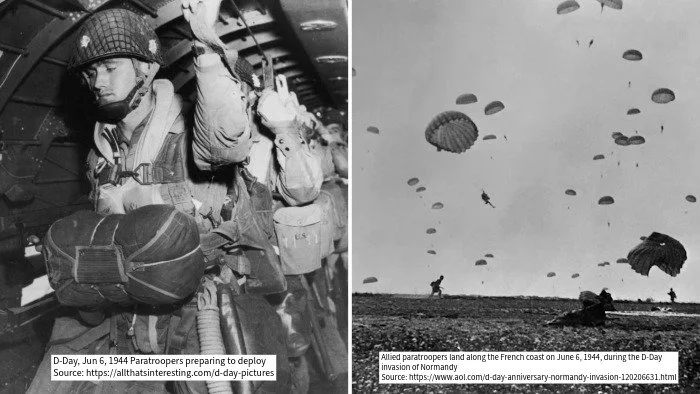
To understand the PLF, you have to go back to the early 1940s. It was a time when landing under a parachute was far less predictable, and far less forgiving to the body.
The concept of military airborne units was still new when the U.S. Army formed its first Parachute Test Platoon in August 1940. (6) During World War II, as airborne operations expanded in response to war time needs, troops were deployed using round parachutes. (7) These parachutes, like the T-4 and T-5 systems, offered very limited control for the parachutists.
Once a soldier exited the plane, their ability to direct where and how they landed was quite small. Wind direction, terrain, obstacles, and timing all introduced variables that couldn’t be corrected mid-air. A lot of praying and luck were involved.
Combine all of these factors, and the serious problem of landing injuries became apparent early on during military training sessions. (8) Imagine trying to park a car without a steering wheel and you might get the idea.
Soldiers were landing on the ground with significant impact to their body. This impact often occurred in awkward positions, and led to absorbing the shock through their legs or spine in unnatural ways. In many cases, the landing was the most dangerous part of the operation. Well, at least outside of being shot at.
In reality, although scary to the lay person, sailing through the sky was the easy part.
What the military realized a short time after 1940 wasn’t that better training for in air decision-making was needed. After all, no decisions could really be made in the air. Instead, they needed areliable landing solution for high-speed impacts.
The PLF, adapted from British landing techniques, emerged as that solution with a notable impact on injury rates for the better. (8)
It wasn’t designed to look graceful. It was engineered around one very specific goal, to reduce injury when impact is unavoidable and unpredictable.
To do that, the technique had to meet several criteria to be an effective tool:
Simple to teach and repeat across large groups of soldiers
Effective in any landing direction, regardless of wind direction
Protect critical body structures, especially the spine and head
Distribute force across the body, rather than concentrating it in the legs
Require minimal decision-making in the moment of impact
The PLF wasn’t a technique that was randomly stumbled upon. It was a clear example of applied safety science, although it may not have been called that in those days.
It took a complex problem (human bodies hitting the ground under changing conditions), and reduced it to a repeatable technique for reduced injury risk. A technique that didn’t rely on perfect timing, perfect conditions, or perfect control. Just repeated training for automatic performance upon landing.
The technique was essentially made for a universal truth of skydiving;at some point, things will not go as planned. And when they don’t, how you meet the ground matters.
The Universal Physics of Falling
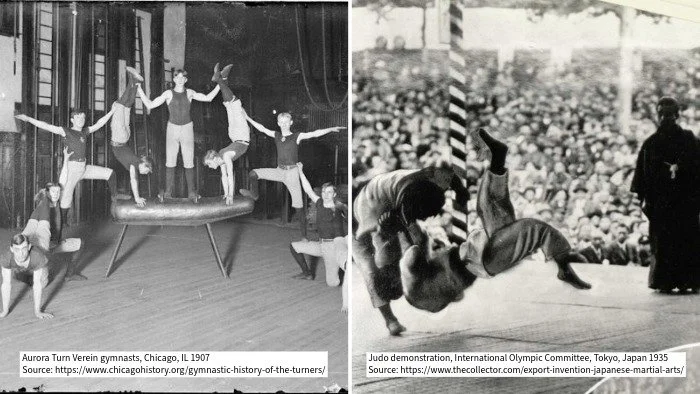
One of the more interesting aspects of the PLF is that it wasn’t created in a military bubble. However, it also wasn’t the product of a well-developed, widely shared “science of falling.”
At the time the PLF was developed in the 1940s, there were already systems of movement that addressed how to safely fall.
In gymnastics, athletes had been practicing rolling techniques to some degree since the late 1800s to manage bad landings, which in themselves had roots back to ancient Greece. (9) Martial arts, particularly Japanese systems like judo, used a falling system called ukemi. (10) This system taught practitioners how to disperse force, protect vulnerable body regions, and recover safely from a fall. Decades later, ukemi would directly influence many of the falling techniques used in parkour. Athletes adapted these ideas to the realities of modern concrete environments in a falling system called parkour ukemi.
But these practices were not widely known outside their respective disciplines, especially during the 1940s. They were not part of standard military training, and there was no easily accessible resource explaining how humans should land safely.
There was no modern sports science. No widespread video analysis. No parkour safety rolls demonstrated online. No comprehensive resources on fall mechanics.
The PLF came about before all of that.
And yet, when you look at it closely, something interesting happens. You’ll notice the PLF arrives at many of the same solutions developed independently by gymnasts, martial artists, and later parkour athletes.
If we step back from skydiving and look at the PLF purely as a falling strategy, it isn't particularly unique. In fact, it's surprisingly ordinary against modern standards.
Across different disciplines and time periods, people faced with solving the problem of falling tend to arrive at surprisingly similar answers.
In martial arts, practitioners learn ukemi.
In gymnastics, athletes learn to tumble and roll out of bad landings.
In parkour, practitioners use safety rolls to redirect momentum after drops and jumps.
And in skydiving, jumpers use the PLF.
The details differ, but the underlying principles remain consistent. Each system attempts to spread impact forces across the body, lengthen the duration of impact, protect vulnerable structures like the head and spine, and redirect momentum rather than stopping it abruptly.
From a Science of Falling perspective, this is exactly what I would expect.
When different groups of people are forced to solve the same physical problem (how to hit the ground without getting injured) they often end up with similar solutions. Not because they copied one another, but because physics narrows the range of potential answers.
There are only so many ways to safely dissipate large amounts of energy during a fall.
The PLF is one version of that solution. Parkour rolls are another. Martial arts breakfalls are another. Gymnastics provides several more.
Within Science of Falling, I group these ideas under a broader framework I call ROLL SAFE:
Relax the body
Observe the surroundings
Lengthen the fall
Land on soft areas
Shield the head
Absorb, Flow, Exhale (don't fight the fall)
The PLF aligns with these principles almost perfectly.
It spreads impact across the body, increases the time available to absorb force, protects vital body parts, and transforms a potentially damaging collision into a controlled sequence of contact along the body.
Different cultures. Different environments. Different time periods. Yet the same underlying physics always leads toward similar answers.
The PLF is not simply a skydiving technique under the hood. It is one example of a much broader and more universal truth. When humans learn to fall safely, they often discover the same solutions.
The Biomechanics of the PLF
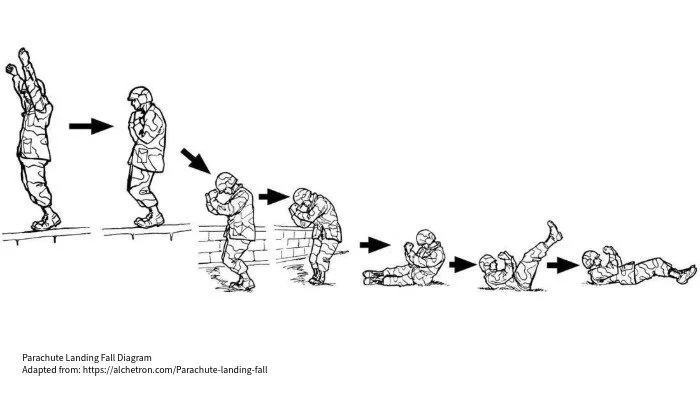
At its core, the PLF is a strategy for managing the energy of a fall.
When a skydiver reaches the ground, their body still carries a high level of falling energy, both in the vertical and horizontal directions. That energy has to go somewhere, but hopefully not all into the jumper. If the body stops abruptly, a massive amount of force slams into small areas, like the ankles, knees, or spine. And that leads to injury and a very bad day for the skydiver.
The PLF changes how that energy is managed upon ground impact.
Instead of stopping all at once, it spreads the impact over time and across multiple body segments. From a physics standpoint, this does two critical things:
Gives the body more time to slow down, kind of like gently applying the brakes of a car
Spreads impact across multiple points of the body to lower the impact on any one body part
The secret to this is a sequenced contact pattern.
Rather than landing stiff and upright, the body moves through a controlled pattern of contact over six body areas (5):
feet → calf → thigh → hip → torso → shoulder
Each body segment absorbs a portion of the landing energy, passing the remaining energy along to the next. The result is not a single bone-shattering impact, but a series of smaller more manageable hits.
At the same time, the PLF redirects falling energy.
Instead of allowing the vertical force of the descent to compress straight down through the spine, the PLF transforms that downward energy into a rolling motion. The jumper’s body effectively rolls across the landing terrain. This converts a dangerous vertical crash into a safe spin across the ground, bleeding off the speed and impact energy.
This principle should sound familiar. It’s the same underlying idea seen in:
Parkour safety rolls
Judo ukemi falling techniques
ROLL SAFE principles
Different environments, different movements, different intentions, yet the same physics at play.
In each case, the goal is always the same:
Avoid sudden stopping
Spread impact energy over large soft areas of the body
Lengthen the duration of the fall to absorb less force per second
Protect vulnerable body areas like the head and spine
From an injury perspective, this matters a ton. A poorly executed landing tends to concentrate impact force through:
Ankles and feet
Knees
Spine
The PLF saves these areas by re-distributing load across a wider area of the body. The head is kept tucked and protected from the ground, the spine avoids aggressive vertical loading, and no single joint takes the full force of impact.
This brings us back to an important point.
The PLF isn’t valuable just because it’s a “skydiving technique.” It’s valuable because it reflects afundamental principle of how the human body can safely interact with the ground during a fall.
That principle doesn’t change with technological improvements. It’s a fundamental aspect of physics.
The ability to safely spread-out force during a fall is always a useful safety skill. This is true even if modern parachutes lead to less need for specific falling techniques.
How Technology Changed the Role of the PLF
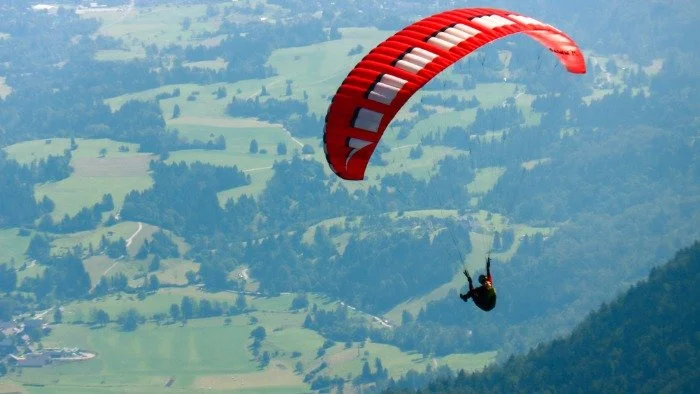
The role of the PLF can't be separated from the equipment it was originally designed for.
As mentioned earlier, when the technique was developed in the early 1940s, military parachutists were jumping under round canopies that offered very little control. Once a soldier exited the aircraft, there was only so much they could do to influence where and how they landed. Wind, terrain, and timing often determined the outcome.
Under those conditions, the PLF wasn't simply helpful, it was an essential injury reducing skill.
Paratroopers practiced it repeatedly during ground drills and training jumps until it became automatic. (8) Their expectation wasn't that every landing would go perfectly. It was that eventually one wouldn't. The PLF provided a standardized, scalable way to reduce injuries when that happened.
As parachuting evolved, however, so did the technology.
The introduction of ram-air canopies, around the 1960s-70s, changed the nature of landing entirely.(11) Unlike the older round parachutes, modern canopies function more like wings. (12) They generate lift, glide forward, and can be actively controlled throughout descent. Skydivers gained the ability to steer precisely, manage their approach, and use a flare to dramatically reduce landing speed before touchdown.
As a result, stand-up landings became not only possible, but expected.
Instead of preparing to absorb impact through a fall, the goal became to avoid needing a fall at all.
This technological shift was enormously successful. Modern parachutes have dramatically reduced the frequency of hard landings and improved overall safety throughout the sport. (8)
But they haven't changed the underlying physics.
Momentum still exists.
The ground remains unforgiving.
And when something goes wrong, the body still has to absorb the impact.
What changed wasn't the need for force management. What changed was how often jumpers expected to need it.
As hard landings became less common, the role of the PLF gradually shifted from:
mandatory training
frequently practiced
commonly expected to be used during a landing
to:
necessary for certifications
occasionally reviewed safety skill
useful primarily in emergencies
Over time, this quite possibly lead to a cultural shift within parts of the skydiving community.
A technique that once sat at the center of parachute training became something that, for some jumpers, may receive less attention once initial training is complete. As equipment improved and stand-up landings became the norm, the PLF naturally shifted toward a more specialized role focused on unexpected or difficult landings.
This evolution helps explain ongoing discussions about the PLF's role in modern skydiving.
Today, few skydivers would argue the PLF is valueless. The discussion is more about how much emphasis it should receive now that parachutes are so controllable.
Some jumpers may view it primarily as a backup skill designed for situations that are now encountered less frequently. If modern canopies make hard landings relatively uncommon, spending large amounts of training time on PLFs can seem unnecessary. Some may argue that the technique feels awkward to practice or carries its own risks if performed incorrectly.
Others may emphasize a different perspective, just like my skydiving contact does.
They may point out that modern equipment reduces risk but doesn't eliminate it. Weather changes unexpectedly. Pilots make mistakes. Off-target landings occur. Equipment can malfunction. And hard landings remain a significant source of injury within the sport.
From this perspective, the PLF is simply a form of safety redundancy.
Like a seatbelt, it isn't valuable because it's needed every day. It's valuable because it exists for the moments when everything else fails.
The changing role of the PLF reflects a much broader pattern that extends far beyond skydiving.
As technology improves and outcomes become more predictable, our perception of risk decreases. When perceived risk decreases, motivation to practice backup skills often decreases as well.
This creates a paradox of safety. The environment becomes safer overall, but people become less practiced at handling the situations that remain dangerous.
The PLF's journey from essential skill to primarily backup safety skill is ultimately a reflection of that larger pattern.
Technology changed the frequency of hard landings. It never changed what happens when the ground wins.
Alternative Landing Techniques and Environmental Challenges
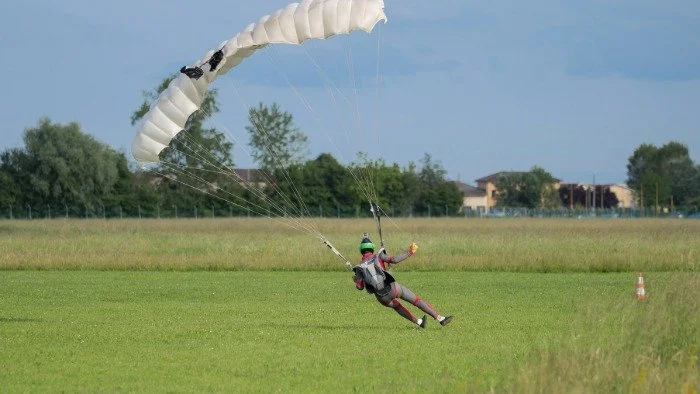
As parachute control improved, so did the range of landing options available to skydivers.
If you were to jump out of a plane today, the goal in most situations is not to fall upon landing. Instead, it’s to transition smoothly from flight to standing. When everything goes right, this is both efficient and safe.
In fact, this is exactly how most skydivers land in YouTube videos and GoPro footage. For many of us, that may be the closest we will ever be to seeing these landings in action.
The most common technique is the stand-up landing, with a PLF only used in more uncontrolled situations. (5)
With decent skill and a well-timed flare, vertical and forward speeds are reduced just enough for the jumper to step onto the ground, often finishing with one or two steps. In ideal conditions, this is the cleanest and lowest-impact way to land.
But landings don't happen in ideal conditions all the time.
Even with excellent canopy control, the environment still plays a large role in how impact is experienced. Wind can shift suddenly. Turbulence can develop near obstacles. Visibility can be reduced. Terrain can be uneven, sloped, soft, or unforgivingly hard.
The landing surface itself matters as well:
Grass can provide some forgiveness and allow for running or sliding landings
Sand may absorb impact but can also create instability
Asphalt and hard-packed surfaces offer little cushioning
Uneven ground makes controlled foot placement more difficult
When conditions aren't perfect, other landing strategies become useful.
A running landingallows the jumper to burn off forward momentum over multiple steps rather than stopping abruptly.(5)This works well when forward speed is moderate and footing is stable.
A slide landing can also be effective when running isn't viable or practical. (5) By allowing the body to slide along the ground, momentum is spread over time and surface area. However, this approach is highly dependent on terrain. What works well on grass may become risky on rough or uneven ground.
Each of these techniques has its place, but they share the common assumption that the landing can be predicted and managed in advance.
The PLF throws that assumption out the window.
It isn't optimized for ideal conditions. It's designed for situations where control is incomplete, timing is imperfect, or the exact nature of the landing isn't fully known ahead of time. Rather than relying on precise footing, perfect timing, or favorable terrain, the PLF focuses on the one thing that remains constant, the physics of impact.
That's what makes it so time-tested and durable as a safety technique.
Different situations call for different landing strategies, but the need to manage momentum never goes away. Whether you step, run, slide, or roll, your body is really just doing one thing, figuring out how to absorb energy safely when you hit the ground.
The PLF is simply the strategy designed for when the answer to that question is uncertain.
Lessons Beyond Skydiving
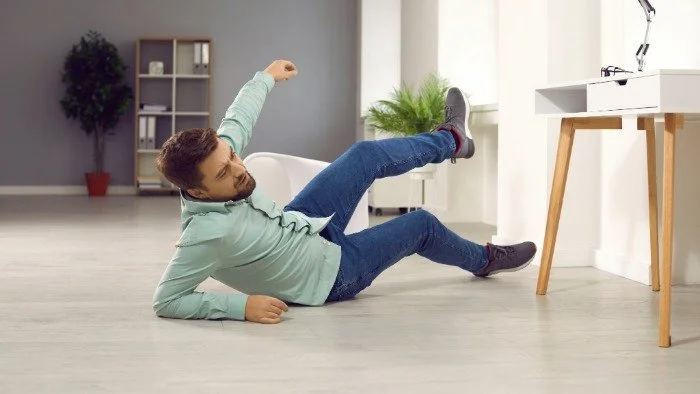
The PLF might seem like a niche technique, useful only to a specific group of people in a specific environment. But the principles behind it are far more general as we’ve discussed.
Because at a fundamental level, this article isn’t really about skydiving. It’s about what happens when a person meets the ground uncontrollably. And in any complicated, real-world environment, that impact is never completely avoidable. It can only be managed with skill and knowledge.
People slip, they trip, they misjudge distances, and they encounter unexpected conditions. Falls are an inevitable part of life. Most of us simply don't expect them to happen until they do.
What matters is not whether a fall happens, because eventually it will. What matters is how it is handled.
The PLF illustrates the simple but important idea that skill matters most when control fails.
As long as everything goes according to plan, protective techniques may not seem important. But when timing is off, conditions change, or assumptions break down, the ability to manage impact suddenly becomes incredibly valuable.
This raises an interesting question. If these principles are so useful, and so widely rediscovered across different disciplines, why do people stop practicing them?
The answer has less to do with usefulness and more to do with human psychology.
One of the biggest factors is perceived risk of an activity. When outcomes are consistently good and safe, the need for backup safety strategies feels less urgent. In modern skydiving, most landings are controlled, stand-up landings are common, and equipment is highly reliable.
As a result, it becomes easy to think, "It won't happen to me."
This is a form of optimism bias, the tendency to underestimate the likelihood of negative events in our own lives.
Alongside that is the simpler issue of discomfort. Protective skills often require intentionally practicing awkward movements such as falling, rolling, or absorbing impact. Without an immediate need, many people avoid that kind of training because it can feel uncomfortable, risky, or simply unnecessary.
I was a victim of this mentality when I first started in parkour. Shoulder rolls were highly uncomfortable, so I avoided practicing unless it was on a soft matted surface. This stunted my growth as an athlete and made me woefully unprepared in terms of safety for real world hard surface training.
Then there's also the problem of skill invisibility.
PLFs won't earn applause. Nobody notices the value of a protective skill when everything goes well. If every landing is clean, it's easy to forget the purpose of a technique designed for the moments when things don't go well.
As a result, these skills can feel unnecessary even when they function as a form of safety insurance.
This creates the paradox of safety. Better technology often leads to better outcomes. Better outcomes can reduce perceived risk. Reduced perceived risk may reduce motivation to practice backup skills. Over time, those skills may be emphasized less frequently and may gradually fade from the culture.
The environment becomes safer overall, but individuals may become less prepared for the moments when it isn't.
And this pattern isn't limited to skydiving.
You see it in sports, where athletes often spend more time training performance than fall safety. You see it in aging populations, where reduced exposure to the ground can decrease the ability to recover from a fall. You see it in everyday life, where most people rarely practice how to move safely during unexpected situations because the modern world is generally forgiving.
Yet the underlying problem remains the same.
Falls don't disappear simply because we expect them to be rare.
This is why similar protective strategies appear across so many different disciplines:
In sports, athletes learn to absorb and redirect force during collisions and mistakes.
In parkour, practitioners train to convert impact into motion through rolling and redirection.
In martial arts, falling safely is practiced alongside striking, grappling, and throwing.
In aging populations, maintaining the ability to get down to and up from the ground can influence both independence and injury risk.
Different environments. Different goals. The same underlying challenge.
You shouldn't fight the ground. You should learn how to meet it on your terms.
The PLF is one example of that idea, but the lesson it represents applies far beyond skydiving. And when a fall eventually does occur, the difference between injury and recovery often comes down to whether the body has learned, at some point, how to handle the impact.
Final Thoughts: Falling Is a Skill, Not a Failure

The modern discussion around the PLF isn't just about skydiving technique. It reflects a deeper misunderstanding of safety preparation and falling itself.
In many contexts, falling is treated as something to avoid entirely, a sign that something has gone wrong. And while prevention is important, this mindset overlooks the critical reality that not all falls can be prevented.
What can be influenced is what happens next, after the fall starts.
Across history and across disciplines, humans have repeatedly developed ways to manage impact more safely. Whether it’s the PLF, a martial arts breakfall, gymnastics somersault, or a parkour safety roll, these techniques all point toward the same idea; the body can be trained to meet with the ground more effectively. And that training matters.
Preparation doesn’t eliminate risk, but it changes how that risk is experienced. It can turn a high-force, injury-prone event into something more controlled and more survivable.
Which brings us back to the central theme of this article while using the PLF as a trojan horse of sorts:
Technology improves
Systems become safer
Outcomes become more predictable and expected
Yet the fundamental physics of impact never changes when something goes wrong
When control fails, your body still has to meet the ground. And in that moment, the difference isn’t the equipment you have. The difference is whether you have the skill to manage the impact.
Falling well should never be a backup plan, it should be a fundamental human ability just like using the brakes in a car. Falling is a skill that should always remain relevant no matter how advanced the safety systems around us become.
The PLF stands as a fundamental example of that idea in a sport that quite literally is centered around falling.
What’s Your Fall Risk Score?

Most people don’t notice their balance declining until something goes wrong.
This 10-minute self-assessment will show you:
• How stable your balance really is
• Where you're most at risk (strength, coordination, or falling ability)
• What to focus on first
No equipment. No guesswork. Just clear answers.
References
How Safe is Skydiving? | USPA. https://www.uspa.org/discover/faqs/safety
Crouch J. A Milestone in Safety—The 2024 Fatality Summary. United States Parachute Association. https://www.uspa.org/uspa-news/a-milestone-in-safetythe-2024-fatality-summary. Published June 23, 2025.
Webster AP, Bureau of Medicine and Surgery, Navy Department. FREE -FALLS AND PARACHUTE DESCENTS IN THE STANDARD ATMOSPHERE.; 1947. https://ntrs.nasa.gov/api/citations/19930082042/downloads/19930082042.pdf?utm_source=copilot.com
BiologyInsights Team. How Fast Do You Fall With a Parachute Open? - Biology Insights. Biology Insights. Published November 28, 2025. https://biologyinsights.com/how-fast-do-you-fall-with-a-parachute-open/
United States Parachute Association, 2024 SIM Rewrite Task Force. Skydiver’s Information Manual 2026. United States Parachute Association; 2026. https://uspa.org/downloads
Wysocki D. #OnThisDate August 16, 1940: Sky Soldiers. History-Collectors.com. Published August 16, 2025. https://history-collectors.com/blogs/archives-history-collectors-com/onthisdate-august-16-1940-sky-soldiers
Msw. US parachutes - WarHistory.org. War History. Published December 13, 2024. https://warhistory.org/article/us-parachutes
Knapik JJ. An Ongoing Series: United States Military Parachute Injuries. Part 2: Interventions Reducing Military Parachute Injuries in Training and Operations. Vol 19.; 2019:110-. https://jsomonline.org/wp-content/uploads/2024/02/20194109Knapik.pdf
Sokol Museum. History of Gymnastics - Sokol Museum. Sokol Museum. Published July 21, 2023. https://sokolmuseum.org/history-of-gymnasts
TACHIMOTO M, HATAKEYAMA M, Teikyo University of Science, Roomy AL, ONDA T, Tokai University. The concept of Ukemi in the Early Stages of Judo Development: Part 1 - What does it mean to fall? Rolling and falling techniques. International Consensus Conference on Safe Falling for Older People Through Judo. Published online 2021. https://judospace.com/wp-content/uploads/2025/01/Tachimoto-The-Concept-of-Ukemi-in-the-Early-Stages-of-Judo-Development-Part-1_What-Does-It-Mean-to-Fall.pdf
DZGone.com - a nostalgic look back at drop zones from the past. https://www.dzgone.com/dropzones/poppenhager.html
Weiberg JA, Mort KW, Ames Research Center. WIND-TUNNEL TESTS OF a SERIES OF PARACHUTES DESIGNED FOR CONTROLLABLE GLIDING FLIGHT. NATIONAL AERONAUTICS AND SPACE ADMINISTRATION; 1967. https://ntrs.nasa.gov/api/citations/19670015726/downloads/19670015726.pdf