

Updated: 8/10/2026
Essential Points:
Arm contact can help control a fall, but a forceful slap may not be necessary. Using the arms to establish contact, distribute load, and guide the body can be valuable without intentionally driving the arm into the ground.
The surface changes the risk-benefit equation. A forceful slap may be tolerable on padded martial arts mats, but hard surfaces like concrete and asphalt can increase the consequences of concentrated impact through the hand, wrist, elbow, and shoulder.
Think “Reach → Contact → Absorb → Decelerate.” Rather than treating the arm as a tool for creating another impact, use it as an active contact point that helps slow, control, and distribute the forces of a fall.
Prefer to listen? Play the podcast version of this article below!
Have you ever watched a martial arts demonstration and marveled at how the fighters seem to fall gracefully, even when they’re thrown to the ground with a lot of force?
You might have noticed that, in some instances, they even use a quick, forceful motion of the arm towards the ground, a technique often referred to as “slapping-out”, to seemingly control the fall. Although it’s been taught as a way to decrease the impact of a fall, I’ve personally always been skeptical.
My understanding of biomechanics and physics makes me feel this just adds local force to the arm when falling. Consequently, I tend to wonder if the forceful slap itself is necessary to make the technique effective, and does that risk-benefit calculation change when the fall occurs on a hard surface?
In today’s article, we’re going to look specifically at that question. Importantly, I’m not arguing against ukemi or against using the arms during a fall. Both can be extremely valuable.
Instead, I want to separate useful arm contact from the intentional forceful slap and examine the physics, biomechanics, research, and real-world context behind each. Along the journey we’ll also compare it to another rising sport that delves into falling techniques and borrows heavily from judo ukemi techniques, parkour.
Why Analyze the Slap-Out Falling Technique?

So why should we take the time to analyze the slap-out technique often taught in martial arts?
The simple answer is that understanding the mechanics of falling isn’t just for martial artists, it’s for anyone who moves through the world and wants to reduce the risk of injury. Falls can happen anywhere, whether you’re practicing a complex move or simply navigating everyday obstacles. Knowing which techniques are safest can be the difference between a minor bruise and a serious injury. Especially when those techniques are taught to tens of thousands of people a year.
Moreover, in an era where we increasingly look to scientific research to validate traditional practices, examining a technique like slapping-out is crucial.
It challenges long-held assumptions in martial arts training and offers insights that could influence how we teach safe falling methods across a variety of disciplines. Of course, when going up against tradition, we must analyze and critique with valid resources and principles. After all, if something has survived for hundreds or thousands of years it probably has done so for a reason.
The Big Question: Is the Slap-Out a Friend or Foe?
At the heart of our discussion is the pressing question, “Can slapping-out during a fall be a reliable method to reduce injury, or does it unintentionally increase the risk of harm?”
As we explore both the historical context and the modern scientific perspective, you’ll be invited to form your own opinion. The goal here isn’t to take sides but rather to present a well-rounded view of the technique’s merits and shortcomings, albeit from my own personal viewpoint.
So, whether you’ve ever tried a “slap” on the ground yourself or simply witnessed it in a class, prepare to learn the mechanics behind the motion, and learn why context is everything when it comes to falling safely.
What Is Slapping-Out?

Let’s turn our focus to understanding exactly what I mean by “slapping-out.” This section will cover the definition, origins, and traditional context of the technique. We’ll also look at how it contrasts with similar methods used in other disciplines, like parkour.
What Do I Mean by “Slapping-Out”?
At its core, slapping-out refers to a rapid, forceful movement of the arm toward the ground during a fall, producing the characteristic audible slap seen and heard in many martial arts breakfalls.
Imagine you’re in a martial arts class and you’re being thrown to the ground. Instead of simply tucking or rolling, you quickly swing your arm down to meet the floor as the rest of your body lands. The idea is to “catch” part of the fall, spread impact across a larger area of the body, and help protect more vulnerable regions.
It is a quick, almost reflex-like movement that many martial artists practice repeatedly. If you’ve ever walked past a martial arts gym, you’ve probably heard the unmistakable sound of people practicing these breakfalls.
Importantly, the slap is only one part of a much larger ukemi strategy. I’m not arguing that the hands and arms should be kept away from the ground. Actually, I’m a firm believer in the opposite. During some falls, moving the arm quickly enough to meet the ground can create an earlier contact point, help guide the body, assist with rotation, and contribute to spreading the impact.
The distinction I want to explore is what happens once the arm reaches the surface. Should the arm meet the ground and begin helping control and slow the descent, or is there an additional benefit to continuing to accelerate the arm into the ground to create a forceful slap?
That specific question, not whether the arms should be used at all, is the focus of this article.
Traditional Context and Purpose
Forceful arm contact is taught within the breakfall techniques of several martial arts, most notably as one component of broader ukemi training. It should therefore be understood in the context of the entire movement rather than evaluated as an isolated slap.
Traditional Martial Arts Context:
In disciplines like karate, judo, and aikido, the training environment is often designed to simulate combat scenarios while minimizing injury. Padded floors and controlled conditions enable practitioners to experiment with different methods of falling without significant risk of injury. It’s fair to assume that over time instructors observed that a rapid, forceful slap with the arm could sometimes help distribute the force of a fall away from more vulnerable areas like the head.
Intent Behind the Technique:
The primary goal was, and often still is, to protect the most critical parts of the body. By slapping-out with the arm, a martial artist might redirect the energy of the fall, ideally protecting the head and spine. In many traditional schools, this technique was integrated as part of a broader curriculum on ukemi, or falling safely, which also includes rolling and other energy-dissipating methods.
Evolution Through Practice:
Over decades of training and sparring, martial artists refined slapping-out into a sort of instinctive response. While not every fall is the same, the technique developed as one possible way to mitigate injury during unexpected impacts. It’s a testament to the idea that sometimes, in the heat of the moment, our bodies learn to perform protective maneuvers that feel natural, mainly due to hours and hours of practice.
A Historical Thought Experiment:
This next idea is more speculation than a historical conclusion, but I think it raises an interesting question. Martial arts and their falling systems developed across long periods of history and under training and environmental conditions that were not necessarily identical to the concrete, asphalt, and tile-heavy environments many of us live in today.
Could the surface on which a falling technique is practiced influence which parts of that technique transfer best to the real world?
A forceful slap that is comfortable and repeatable on tatami (Japanese style padded flooring) or another forgiving training surface may have a very different risk-benefit ratio on concrete. I don’t have evidence that historical environments caused the slap-out technique to develop in a particular way, so this should be viewed as a thought experiment rather than an explanation of its origins.
However, it highlights an important principle. Falling techniques should be evaluated not only by how they perform during training, but also by how they work in the environments where real falls occur.
If you’re interested in the deeper history of ukemi and how these martial arts falling techniques eventually influenced parkour, I explore that story in my parkour ukemi origins article.
How Is Slapping-Out Practiced?
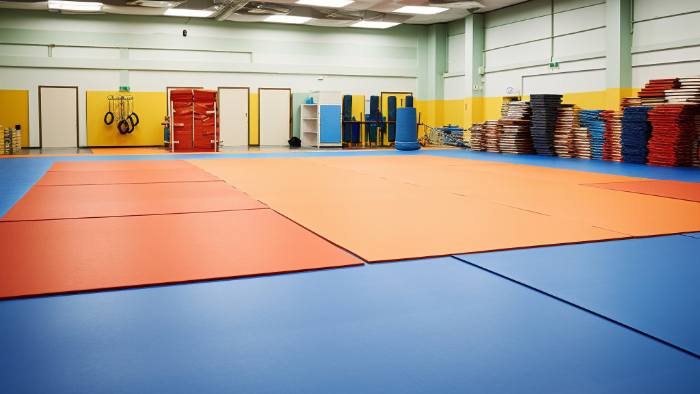
In the controlled environments of martial arts dojos, slapping-out is often just one component of a larger system of fall techniques. Here’s what that looks like:
Padded Floors and Controlled Movements:
Most martial arts training takes place on cushioned mats or tatami. These surfaces absorb a portion of the impact, making it safer to experiment with different techniques, including slapping-out. In such settings, even if the technique does increase localized forces on the arm, the overall risk of injury is mitigated by the softness of the floor.
A Built-In Safety Net:
Instructors often teach students to combine slapping-out with other protective measures. For example, a typical training session might include:Rolling Techniques: After the initial contact, a roll helps dissipate the remaining energy if angular momentum is present.
Controlled Tucking and Elongating: In some scenarios, practitioners are taught to tuck their bodies or elongate in order to lengthen the time of the fall and dissipate impact forces over a longer period of time.
Sequential Movements: Rather than relying solely on a single, abrupt slap, the arm’s movement is sometimes part of a sequence designed to spread the force over a larger area and a slightly longer period.
The Mindset of a Martial Artist:
There’s also a mental aspect to the technique. Martial arts training often emphasizes trust in your body’s reflexes. Practitioners learn to react quickly, and in the controlled environment of a dojo, this reflexive slap might feel like the most natural, and safest, option available.
Contrast with Parkour Ukemi: A Different Approach to Falling

Still image from Backwards Falling Tutorial on scienceoffalling.com
If you’re familiar with parkour, you might have noticed that parkour athletes rarely, if ever, use the slap-out method when landing from a fall, even during breakfalls.
Instead, they utilize techniques that emphasize gradual energy absorption. These techniques are termed parkour ukemi and have been adapted from traditional martial arts ukemi, the system that the slap-out is common in. Let’s break down why parkour practitioners favor these alternative methods:
Hard Surfaces Demand Different Techniques:
Unlike the cushioned mats of a martial arts dojo, parkour is often practiced on concrete, asphalt, or other unforgiving surfaces. The hard ground doesn’t offer the same shock-absorbing benefits, meaning that any technique that creates a sudden, concentrated impact, like a forceful arm slap, can significantly increase the risk of injury.A Soft-Touch Approach:
In parkour, the emphasis is on using the arm as a gentle guide rather than a shock absorber. Instead of a quick slap, athletes learn to:Gradually Extend and Flex: Allowing the arm and shoulder joints to bend naturally, which lengthens the deceleration period.
Spread the Force: By engaging the entire body, rolling or dissipating the impact across multiple contact points, parkour practitioners reduce the localized forces that can lead to fractures or soft tissue injuries.
Controlled Impact: The focus is on keeping the body relaxed and fluid, so that the impact is distributed evenly rather than concentrated in a single moment.
This is also true for breakfall type techniques which often lead to a more sudden impact with minimal force distribution opportunities.
Reach, Contact, Absorb, Decelerate:
This is the framework I personally like to teach for arm contact during a fall:
Reach: Move the arm quickly enough to meet the ground when additional arm control is useful.
Contact: Establish contact before a more vulnerable part of the body (i.e., your head) reaches the surface when possible.
Absorb: Allow the elbow, shoulder, trunk, and rest of the body to continue moving rather than treating the arm as a rigid stopping point. Utilize the upper extremity as a compressing spring.
Decelerate: Use that contact to help share load, guide rotation, slow the descent, or transition into a roll.
This is different from simply reaching and striking. The arm may move very quickly before contact. My argument is not that the arm should be slow. It is that once contact occurs, I would rather use that contact to begin managing the fall than intentionally continue driving the arm into the surface to create a harder impact.
Training Environment and Mindset:
Parkour training inherently involves adapting to a variety of surfaces and conditions while using techniques often derived and adapted from martial arts. Athletes are taught to assess their surroundings and choose the safest, most effective way to land a fall. This context-specific approach means that techniques like slapping-out, which might be workable on soft mats, may not be as useful on hard pavement. That’s not to say that traditional judo ukemi systems don’t work, but rather that portions of it aren’t often utilized on hard surfaces for a reason.
The Physics of Falling and Impact Forces

Now that we’ve looked a bit at the technique of slapping out, and used parkour ukemi as a comparison, let’s go deeper on the actual physics of falling. When you’re in the middle of a fall, every split-second counts.
The forces acting on your body are immense, and understanding how they work can change the way you protect yourself. In this section, we’ll break down four key physics concepts, (impulse, momentum, energy dissipation, and force distribution) to explain why how you fall makes all the difference.
Impulse and Momentum
At the core of every impact is the relationship between momentum and the time over which it changes. This is captured in a fundamental physics equation called the impulse equation:
F = Δp / Δt
Where:
F is the average force experienced (measured in Newtons, N).
Δp (delta p) is the change in momentum (momentum = mass × velocity, measured in kg·m/s).
Δt (delta t) is the time interval over which momentum changes (measured in seconds, s).
Impulse is simply the change in momentum, meaning generally a longer Δt results in less average force, while a shorter Δt results in more average force.
Why This Matters When Falling
When you fall and forcefully slap the ground with your arm, it experiences a rapid impact with the surface.
A short Δt (very quick impact) causes a rapid change in momentum, leading to a sharp spike in force locally in your arm.
This high force is concentrated in your shoulder, arm, elbow, wrist, and hand, consequently increasing potential injury risk. (1, 2)
On hard surfaces like concrete or asphalt, which provide very little give and cushioning, these localized impact forces can become especially important.
This doesn’t mean that using the arm during a fall is bad. Quite the contrary, arm contact can be extremely useful for controlling the body and sharing load. The question is whether that contact needs to become a forceful slap.
The Hidden Risk of Slapping-Out: Added Local Momentum
Many assume that slapping-out only redirects or absorbs impact force, but actively accelerating the arm toward the ground can also increase the momentum and impact velocity of the arm itself.
During a fall, your body already has downward momentum due to gravity. When you actively swing your arm down to slap the ground, you introduce additional downward momentum, making the impact more forceful than if you had just absorbed the fall naturally. Research on forward falls has found that wrist velocity at impact is related to peak wrist impact force. (2)
This means:
More Speed = More Abrupt Arm Impact: Your hand accelerates toward the ground before contact, adding local impact forces to the arm rather than reducing it. (2)
Higher Localized Forces: Because the arm is a small structure compared to the whole body, the concentrated force increases the risk of fractures, sprains, or soft tissue injuries. (1, 2)
Importantly, this doesn’t necessarily mean that slapping increases the damaging impact experienced by the body as a whole. The arm can also act as another contact point and potentially redistribute some loading away from other regions.
A Simple Analogy: Landing From a Drop
Think about landing on your feet after dropping from a small height, such as stepping off a box after a box jump.
Your feet need to reach the ground quickly enough to establish contact, but once they do, you usually don’t try to stomp harder into the floor. Instead, your ankles, knees, and hips begin to flex as your muscles work to control and slow the descent.
I think useful arm contact during a fall can follow a similar principle.
The arm may need to move quickly to meet the ground, but once initial contact occurs, the goal should shift from reaching the surface to controlling the remaining descent.
In other words:
Reach → Contact → Absorb → Decelerate
rather than simply:
Reach → Strike
Energy Dissipation and Impact Duration
Now that we understand how momentum and forces can change, let’s discuss why extending impact duration reduces peak force.
A safer fall is achieved when your body decelerates gradually instead of abruptly. Think of it like gently coming to a stop in a car versus slamming the brakes. A longer stop time reduces the force experienced.
When you use techniques that lengthen the time over which you decelerate (i.e., increase Δt), the force acting on your body decreases. This is why many martial artists integrate rolling or controlled movements into their falling techniques when possible, it significantly increases the time over which momentum is reduced. (3)
Real-Life Example: Parkour Ukemi Breakfall vs. Martial Arts Breakfall
Parkour ukemi and traditional martial arts breakfalls share many of the same goals.
Both aim to protect vulnerable areas, spread impact across larger parts of the body, and use the arms as part of the landing. After all, they are derived from the same falling system.
The main difference is often how the arm contacts the ground.
In many martial arts breakfalls, the arm is deliberately accelerated into the surface to create the characteristic slap. In the parkour-style breakfall I use, the arm still plays an active role, but the goal is to meet the ground rather than strike it.
The arm may contact the ground at roughly the same time as the rest of the body spreading the impact over more body surface area, or it may reach the surface slightly earlier and begin helping absorb and control the descent. Once contact occurs, the elbow, shoulder, trunk, and surrounding musculature can continue moving to help slow the body and distribute impact.
Both techniques use the arm.
The difference is what happens at contact. One emphasizes a forceful slap, while the other uses the arm as a controlled contact point to help absorb and manage the fall.
Force Distribution: Why Spread the Impact?
Another important factor in reducing injury risk is how force is distributed across the body.
Using different falling strategies and distributing impact across the body can reduce loading at vulnerable regions. Martial arts falling techniques, for example, have been shown to substantially reduce hip impact forces during sideways falls. (3, 4)
This is one reason arm contact can be useful.
However, a quick forceful slap also creates its own localized impact through the hand, wrist, forearm, elbow, and shoulder. Upper-extremity position, impact velocity, and fall-arrest strategy can substantially influence the forces experienced through the arm. (1, 2, 5)
Ideally, good technique, body positioning, and a softer training surface help manage that load, but poor form or hard surfaces may increase the risk of:
Wrist fractures
Elbow injuries
Soft tissue damage (bruising, ligament strain, tendon injuries)
Load sharing does not necessarily need forceful striking to work.
Benefits of Distributing Forces
Using multiple parts of the body to absorb and distribute force can help reduce excessive loading on vulnerable areas. (1-3, 5) This can be done by:
Using the arms as controlled additional contact points rather than rigid stopping points.
Rolling or bending knees and elbows upon impact, engaging multiple muscle groups to spread out force if the fall allows.
Allowing joints to flex naturally, which acts as a built-in shock absorber.
Spreading the fall over the largest area of body surface possible while aiming to land on the meaty areas such as the lats and glutes.
A Practical Test: The Sound of Impact
Here’s a simple way to think about contacting the ground.
Imagine stepping off the same small height onto the same surface twice. Your own mini-research experiment.
On the first landing, your goal is to make the loudest impact possible. How would you do it?
You would likely land more stiffly, hit the ground harder, hit more abruptly, and create a quick, heavy sound.
On the second landing, your goal is to make the quietest impact possible. How would you do it?
You would likely begin using more ankle, knee, and hip flexion, allowing your body to absorb and slow the landing over a greater amount of time and movement. The sound of contact most likely would be soft and relatively quiet.
Interestingly, researchers have tested a very similar concept. During drop landings, quieter landing sounds were associated with lower vertical ground-reaction forces and greater ankle and knee joint movements. (6)
The difference is easy to feel.
Sound is not necessarily a direct measurement of force. Surface material, body contact area, stiffness, and other factors affect how much noise an impact creates. But when the person, movement, and surface remain similar between two falls, sound can be a useful practical cue for how abruptly the body is contacting the ground. (6)
Now apply that same idea to the arm during a breakfall.
If your goal is to create the loudest slap possible, you have to drive the arm into the surface quickly and forcefully. If your goal is to make the contact as quiet and controlled as possible, you naturally begin thinking about meeting the ground, absorbing the impact, and using the arm to help slow the descent.
Both involve arm contact. The difference is whether that contact is being used to create an impact or manage one.
Impact Physics in a Nutshell
That was a dense section, so here’s a quick summary before we move on:
Impact Time Matters: More abrupt deceleration creates higher loading, while longer deceleration helps reduce and manage force.
Arm Contact Can Help: The arms can guide the body, share load, and help absorb a fall without requiring a forceful slap.
Force Distribution Matters: Spreading impact across multiple body regions helps avoid concentrating excessive load in one vulnerable area.
Research Evidence and Biomechanical Studies

So far, we’ve looked at the physics behind slapping-out. But what happens when researchers actually test different falling strategies?
One of the most useful papers on this topic is a systematic review and meta-analysis by Moon and Sosnoff that examined several strategies designed to reduce impact during a fall. (3)
The Big Finding
The researchers looked at techniques including squatting, elbow flexion, martial arts rolling, muscle relaxation, stepping, and martial arts slapping. Most of the strategies significantly reduced impact loading after a fall.
Martial arts slapping was the exception. In the analysis, it did not produce a significant reduction in impact load. (3)
That doesn’t mean ukemi as a whole is ineffective. In fact, martial arts rolling performed well in the same review. It does, however, raise an important question about whether a forceful slap itself is responsible for the protective benefits often associated with a breakfall.
You can read my full review of the study here.
What Other Studies Add
Other research helps fill in the picture a bit more.
Martial arts falling techniques can reduce impact forces at vulnerable areas such as the hip. (4) This supports the overarching value of ukemi and shows that how the body is positioned and how impact is distributed matters.
Research on forward falls also shows that upper-extremity technique affects the forces experienced through the hands and arms. Elbow position and the way a person arrests a fall can meaningfully change upper-extremity loading. (1, 2, 5)
These studies are not direct tests of a traditional slap-out, but they reinforce the important idea that arm contact can be useful, but how that contact occurs matters. A compliant arm that helps guide, absorb, and distribute the fall is mechanically different from deliberately accelerating the arm into the surface to create a forceful slap.
Surface Matters Too
A padded martial arts floor and a concrete sidewalk are very different environments.
Training mats provide cushioning and allow techniques to be practiced repeatedly with much less detriment to the body. Hard surfaces provide far less help absorbing impact, making localized forces through the hand, wrist, elbow, or shoulder more important to consider.
This doesn’t mean a technique that works on a mat becomes useless outside the dojo. It means the risk-benefit calculation changes with the surface.
Research in a Nutshell
The research does not show that every slap-out is dangerous, nor does it dismiss the broader value of ukemi.
What it does suggest is that the forceful slap itself has less evidence supporting it as an impact-reduction strategy than many other falling techniques.
At the same time, research supports the value of body positioning, joint motion, rolling when appropriate, and distributing impact across multiple contact points. (1, 3-5)
For me, that reinforces a simple falling approach:
Use the arms and body, spread the impact, control the descent, but a forceful slap is not necessarily required to do those things.
Comparing Martial Arts and Parkour Approaches

Martial arts and parkour should not be viewed as completely opposing systems of falling.
Parkour ukemi borrows heavily from martial arts ukemi, and both approaches contain useful ideas about protecting the head, controlling rotation, distributing impact, and avoiding rigid landings. In fact, both practices have influenced my ROLL SAFE framework for teaching the basic principles of safe falling.
Where they can differ is in how those principles are expressed and the surfaces on which they are commonly practiced.
In a padded martial arts environment, a forceful arm slap may be comfortably incorporated into a larger breakfall involving body positioning, tucking, and load distribution across the body. On a harder surface, I become more cautious about intentionally creating that arm impact.
Parkour has strongly influenced my own approach because it encourages adapting the fall to the environment. Rather than removing the arms from the movement, I prefer using them as active participants. Reach when necessary, establish contact, absorb through the joints, guide the body, and continue dissipating momentum.
This leads to my primary disagreement with the traditional forceful slap-out.
I see considerable value in arm contact during a fall, in fact I think it’s a must in most scenarios. I’m just not convinced that making that contact intentionally harder provides an additional protective benefit, particularly when on unforgiving surfaces.
Evaluating the Risks and Benefits of Slapping-Out
Like most falling techniques, slapping-out isn’t “good” or “bad.” Its value depends on how it’s performed, what other movements are used with it, and the surface involved. Context matters.
Potential Benefits
Additional Contact Point: The arm can help spread impact across more of the body and influence how the body reaches the ground.
Movement Control: A well-timed arm reaction may help guide rotation or prevent a more vulnerable area from striking first.
Part of a Larger Ukemi System: On padded surfaces, the slap can be incorporated into a broader breakfall that includes body positioning, head protection, joint motion, and load sharing.
Key Concerns
Localized Arm Impact: A forceful slap creates a rapid collision through the hand, wrist, elbow, and shoulder.
Surface Matters: A slap that is easily tolerated on a padded mat can create much greater localized force on concrete, asphalt, or any other hard surface.
The Forceful Slap May Not Be Necessary: Many of the potential benefits of arm use (load sharing, guiding the body, and helping control the descent) can also occur with a more controlled arm contact.
The important point isn’t whether the arms should be used, but instead how they should be used.
Practical Takeaways for Safer Falls
Regardless of your training background the following tips can help increase safety and control during a fall:
Use the arms as active contact points when they can help guide or distribute the fall.
Reach the ground quickly when necessary, but transition into absorbing and controlling the descent once contact occurs.
Keep joints mobile rather than rigid so the body has more time and distance to decelerate.
Roll when the fall allows it, but recognize that most breakfalls happen because rolling isn’t possible.
Adapt to the surface. The harder the ground, the more important controlled contact and progressive slowing become.
Avoid creating unnecessary impact. If the arm can accomplish its protective role without a forceful slap, a controlled contact may offer the same functional benefit with less localized loading.
The goal is not to remove the arms from a breakfall. It’s to use them to help manage the impact rather than simply add another hard collision to the fall.
Final Thoughts: Tradition is Good, but Not For Everyone

After looking at the biomechanics and research, my position is fairly simple. So simple in fact, some people would say I am splitting hairs. But that’s my job in the world of falling.
Ukemi is valuable. Arm use is valuable. Forceful slapping is the part I question.
The arms can help guide the body, create extra contact points, share load, and help control a fall. But deliberately accelerating the arm into the ground creates a sharp localized impact that may not be necessary to get those benefits. In reviewing the research, I haven’t found clear evidence that making the arm contact forceful adds a meaningful benefit beyond the arm contact and load sharing already occurring during the breakfall without a slap-out.
Surface matters too. A technique that works well on a padded mat may carry a very different risk on concrete, asphalt, or tile.
For real-world falling, I prefer a simple sequence for arm use:
Reach → Contact → Absorb → Decelerate
Get the arm where it needs to be, meet the ground, then use that contact to help manage the remaining descent.
Ultimately, the goal is not to eliminate impact. It is to control it, spread it, absorb it, and protect the body as well as possible.
If you are new to learning how to fall, check out my freefalling tutorial videos to start building your own falling toolbox.
Happy falling!
What’s Your Fall Risk Score?
Most people don’t notice their balance declining until something goes wrong.
This 10-minute self-assessment will show you:
• How stable your balance really is
• Where you're most at risk (strength, coordination, or falling ability)
• What to focus on first
No equipment. No guesswork. Just clear answers.
References
Chou PH, Chou YL, Lin CJ, et al. Effect of elbow flexion on upper extremity impact forces during a fall. Clinical Biomechanics. 2001;16(10):888-894. doi:10.1016/s0268-0033(01)00086-9
DeGoede KM, Ashton-Miller JA. Fall arrest strategy affects peak hand impact force in a forward fall. Journal of Biomechanics. 2002;35(6):843-848. doi:10.1016/S0021-9290(02)00011-8.
Moon Y, Sosnoff JJ. Safe Landing Strategies During a Fall: Systematic Review and Meta-Analysis. Archives of Physical Medicine and Rehabilitation. 2016;98(4):783-794. doi:10.1016/j.apmr.2017.08.460
Weerdesteyn V, Groen BE, Van Swigchem R, Duysens J. Martial arts fall techniques reduce hip impact forces in naive subjects after a brief period of training. Journal of Electromyography and Kinesiology. 2007;18(2):235-242. doi:10.1016/j.jelekin.2008.06.010
Lo J, McCabe GN, DeGoede KM, Okuizumi H, Ashton-Miller JA. On reducing hand impact force in forward falls: results of a brief intervention in young males. Clinical Biomechanics. 2003;18(8):730-736. doi:10.1016/s0268-0033(03)00124-4
Wernli K, Ng L, Phan X, Davey P, Grisbrook T. The Relationship Between Landing Sound, Vertical Ground Reaction Force, and Kinematics of the Lower Limb During Drop Landings in Healthy Men. Journal of Orthopaedic & Sports Physical Therapy. 2016;46(3):194-199. doi:10.2519/jospt.2016.6041.